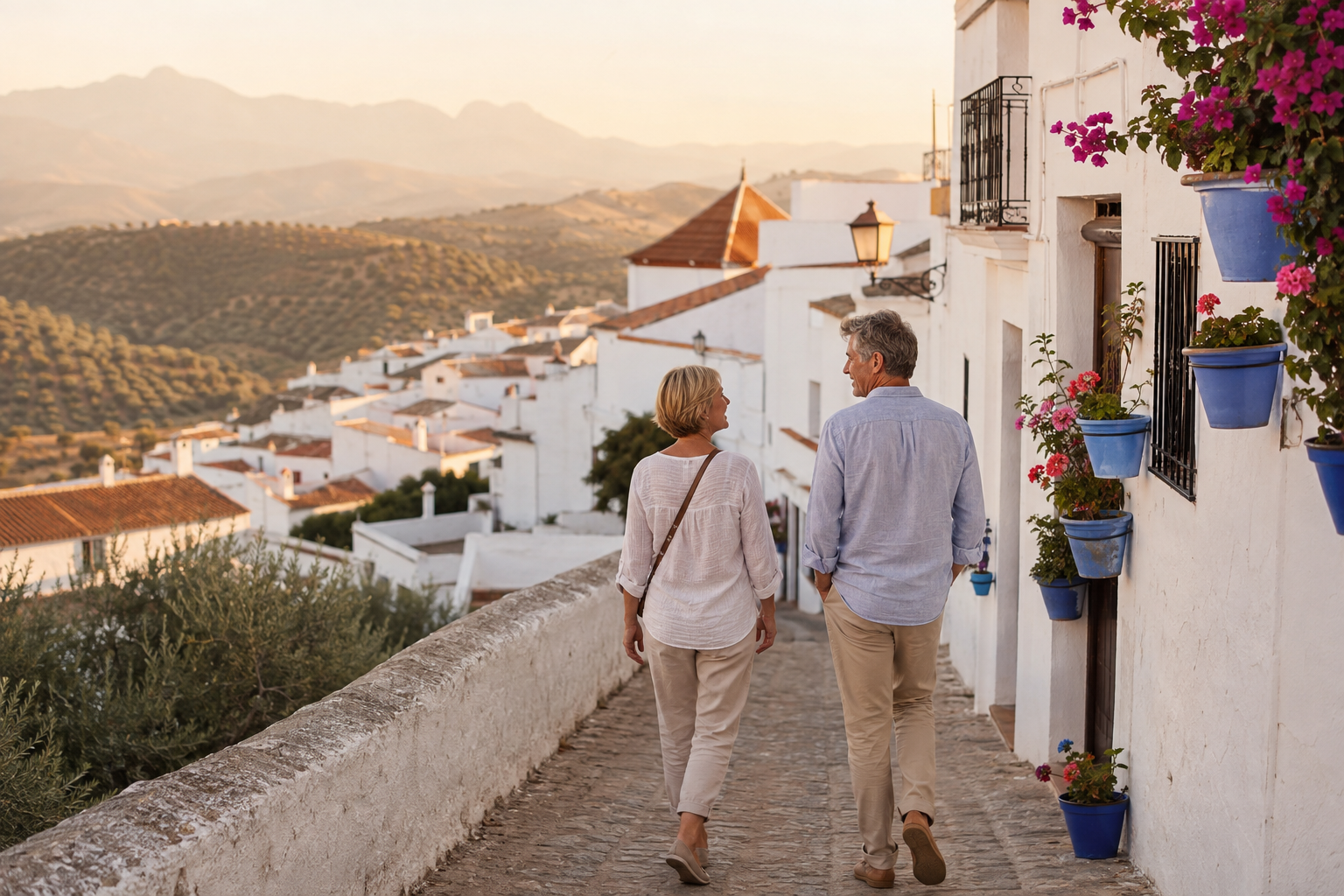
You wake to church bells carrying across whitewashed rooftops. Morning sun warms the terracotta tiles, olive groves tumble toward the valley and the scent of coffee and baking bread drifts up from the lane below.
There is nowhere you must be by nine. The day may hold a village market, a shaded plaza, a short mountain walk and a lunch that takes as long as lunch should. This is slow travel through Andalusia’s pueblos blancos—places where history is not displayed behind glass so much as lived in every lane, courtyard and shared plate.
Here, time does not hurry. It softens.
Why the white villages reward a longer stay
Andalusia carries Roman, Islamic, Jewish and Christian histories across a landscape of sierras, river valleys and olive country. In the provinces of Cádiz and Málaga, white villages climb hillsides once chosen for defence, their narrow streets opening suddenly onto broad views.
Spain’s official tourism site describes a Cádiz White Villages Route with 19 stops. Trying to collect them all turns a restorative trip into a driving challenge. Choose two bases, stay three or four nights in each and let only a handful of villages become familiar.
That approach suits travellers over 50 especially well: meaningful activity without relentless packing, time to adjust plans around heat or energy, and the pleasure of returning to the café where the server already knows how you take your coffee.
A seven-night route that leaves room to breathe
For a first visit, fly into Málaga or Seville, rent a small car and divide the week between the Sierra de Grazalema area and Ronda. Distances can look short on a map, but mountain roads are winding and village parking takes patience.
- Nights 1–4 — Grazalema or Zahara de la Sierra: Use one as your base for quiet mornings, nature walks and gentle day trips to Arcos de la Frontera, El Bosque or Setenil de las Bodegas.
- Nights 5–7 — Ronda or a nearby cortijo: Explore Ronda early or late in the day, enjoy a winery or olive-oil visit and leave one afternoon completely unscheduled.
- Optional coastal finish: Add two nights in Vejer de la Frontera or Cádiz if you want Atlantic air and seafood before flying home.
Which village should be your base?
- Grazalema: Mountain scenery, walking access and a peaceful village rhythm. It is also one of Spain’s rainier areas, so carry a light waterproof layer.
- Zahara de la Sierra: A dramatic reservoir-and-mountain setting with steep lanes and memorable viewpoints.
- Arcos de la Frontera: A historic gateway to the route with excellent views and useful access toward Jerez and Cádiz.
- Ronda: The most complete base for restaurants, services and longer stays—but also the busiest. Visit Puente Nuevo early morning or near sunset.
- Setenil de las Bodegas: Famous for homes and restaurants tucked beneath immense rock overhangs. Fascinating for a day visit; less restful when crowded.
- Vejer de la Frontera: A graceful white town closer to the Costa de la Luz, ideal for pairing village life with Atlantic beaches.
When to go
Andalusia is too varied for one regional forecast. Check the specific village and elevation before each outing, and treat official heat warnings seriously.
- April to early June: Wildflowers, comfortable walking temperatures and lively spring traditions. Holy Week and local festivals can raise prices and crowds.
- Late September through October: Warm days, softer light and excellent conditions for village wandering once peak heat eases.
- March and November: Often good value, with changeable weather and quieter streets. Pack layers and rain protection.
- July and August: Inland temperatures can become dangerously hot, often well beyond comfortable sightseeing weather. Plan only if you are content with early starts, long shaded afternoons and air-conditioned accommodation.
- Winter: Quiet and frequently sunny, but nights can be cold in the hills and some small businesses reduce their hours.
A realistic Canadian travel budget
Prices vary sharply by season, booking date and accommodation style. For a comfortable mid-range trip, a useful planning range is about C$225–C$375 per person per day before flights, assuming two people share a room and car.
- Accommodation: roughly C$140–C$250 a night for many village apartments and guesthouses; C$250–C$450 for boutique hotels, restored farmhouses and historic properties.
- Food: approximately C$8–C$18 for a café breakfast, C$22–C$40 for a menú del día or relaxed lunch, and C$45–C$85 per person for a generous dinner with drinks.
- Car: often C$55–C$100 a day before fuel, parking and optional insurance upgrades; automatic vehicles usually cost more and should be reserved early.
- Experiences: approximately C$35–C$75 for tastings or a guided walk and C$60–C$130 for many cooking classes or intimate flamenco performances.
A comfortable two-week journey for two might land around C$6,300–C$10,500 before international flights. Treat that as a planning frame, not a quote: compare prices in euros and check the exchange rate when booking.
The food is part of the route
Andalusian cooking takes modest ingredients—tomatoes, bread, garlic, olive oil, almonds, pork, seafood—and gives them depth through craft and tradition. Meals are social, and the best ones resist rushing.
Try salmorejo topped with egg and jamón, tender carrillada, local goat cheese, payoyo-style cheeses from the Cádiz mountains and estate olive oils. Near the coast, add pescaíto frito. Around Jerez, taste fino, oloroso or amontillado with guidance; these fortified wines make far more sense beside the foods and people of their home region.
A perfect day may need only a market bag, bread, olives, fruit and a viewpoint. Save one evening for a family-run bar where you can share several small plates rather than order the meal you already recognize.
Seven slow pleasures
- Walk one village shortly after breakfast, before day-trip traffic fills the old centre.
- Tour a family-run olive mill and learn how harvest timing changes the oil in your glass.
- Choose a manageable trail in Sierra de Grazalema Natural Park and confirm whether permits or seasonal restrictions apply.
- Sit in a plaza long enough to notice the local rhythm rather than treating the coffee as a refuelling stop.
- Visit a bodega in or near Jerez and let someone teach you why sherry is a place, not merely a drink.
- Take a market or cooking class, then recreate one dish after you return home.
- Protect one no-driving day for reading, wandering and a long lunch within walking distance of your room.
The moments worth planning around
- See Ronda’s Puente Nuevo in the quiet light of early morning or evening, keeping well back from unprotected edges.
- Watch sunset from Zahara de la Sierra as the reservoir and surrounding hills change colour.
- Walk beneath Setenil’s rock overhangs before tour groups arrive.
- Hear flamenco in a small, respected venue where the focus is the music and dance—not a rushed dinner package.
- Add Doñana only as a dedicated guided outing from the western side of the region; it is not a quick detour from Ronda.
Driving, walking and comfort
A car gives you freedom, but the smallest practical vehicle is usually the best choice. Old streets are narrow, entrances can be confusing and the easiest plan is often to park at the edge of town and walk in.
- Request an automatic transmission well ahead if you need one.
- Download offline maps, but follow posted restrictions rather than blindly obeying navigation software.
- Book lodging with confirmed parking—not merely “parking nearby”—and ask about stairs before committing.
- Wear shoes with grip; polished cobbles and steep lanes can be demanding.
- Build your main outdoor activity before noon in warm weather, carry water and schedule a genuine afternoon pause.
- Choose one village per day. Two can work when they are close; three usually replaces pleasure with logistics.
Could you stay for a season—or retire here?
Andalusia can offer attractive long-stay value, but rent, healthcare access and residency eligibility depend on the exact town and your legal status. A village may cost less than Málaga or Seville, yet a car, summer cooling and older-building accessibility can change the equation.
Spain’s non-lucrative residence visa is one route used by financially independent people who do not intend to work in Spain. Canadian applicants must apply through the Spanish consular office responsible for where they live and provide evidence that can include sufficient financial means, qualifying health insurance, medical documentation and criminal-record checks.
The financial threshold is tied to Spain’s IPREM formula and can change. Do not rely on a rounded figure from a travel article—or assume that qualifying for a visa settles Canadian tax, provincial health-coverage or estate-planning questions. Verify the current checklist with the responsible Spanish consulate and obtain cross-border legal and tax advice before making a move.
The honest trade-offs
- The gifts: layered history, remarkable scenery, deeply rooted food traditions and excellent value outside peak periods.
- The heat: inland summer conditions can be severe enough to reshape the entire day.
- The freedom: a car unlocks the villages and countryside.
- The friction: steep lanes, stairs, tight roads and limited rural transit deserve advance planning.
- The welcome: basic Spanish creates warmer interactions and makes practical problems easier to solve.
- The rhythm: late meals and afternoon closures can feel liberating once you stop fighting them.
The B Side verdict
Andalusia’s white villages are profoundly worthwhile for travellers over 50 who want beauty with texture—not merely a photogenic backdrop. They suit couples seeking shared wonder, solo travellers comfortable with a measured road trip and anyone curious about living more seasonally.
They are less suitable for travellers who dislike hills, need seamless public transit or want every attraction open on a North American schedule. But arrive in spring or autumn, choose two bases and let empty space remain in the calendar. The reward is not how many villages you can name afterward. It is the feeling that, for a little while, you belonged to the light, the table and the hour you were actually living.