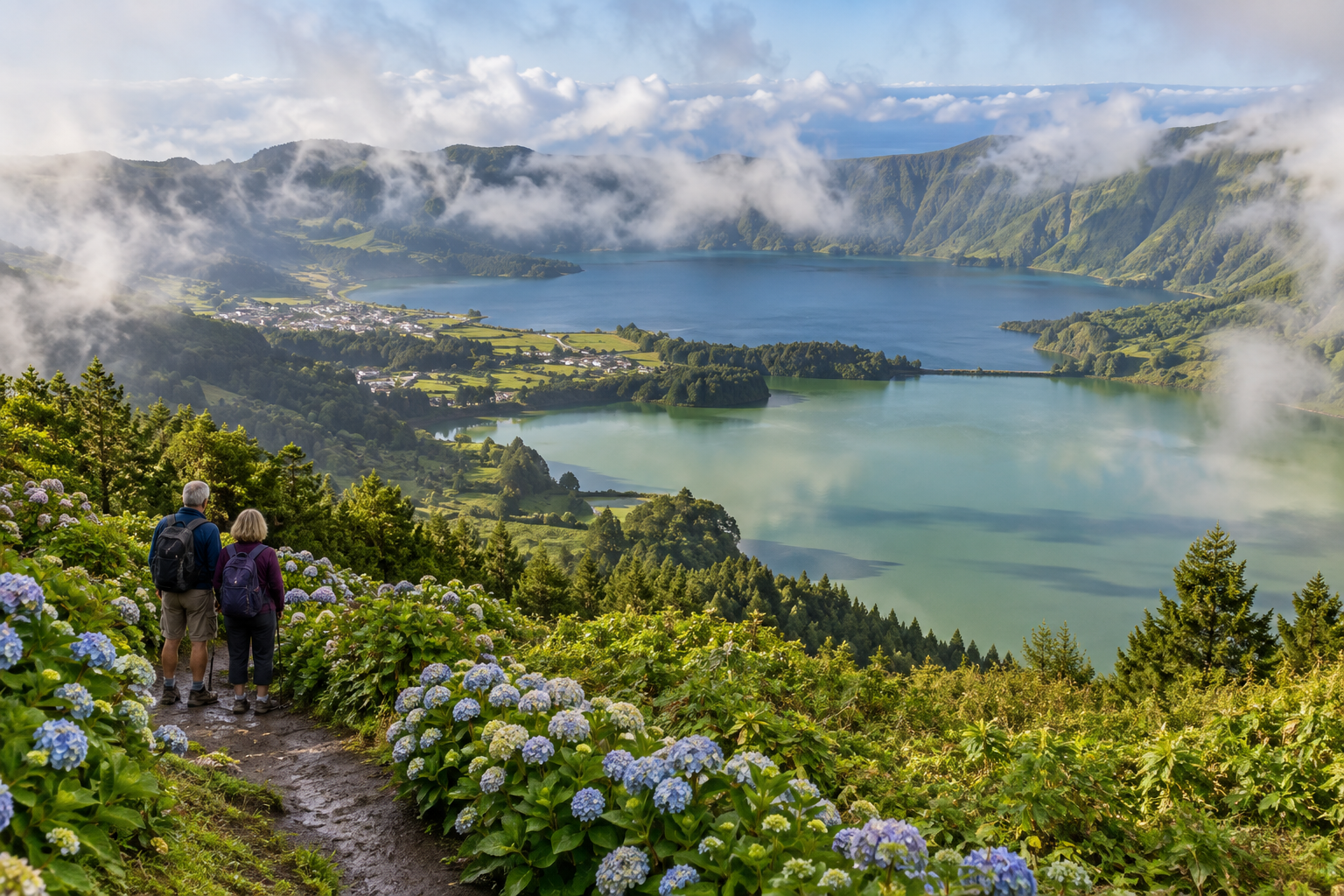
At 8:10 in the morning, the crater at Sete Cidades has disappeared.
Yesterday, you stood at a viewpoint looking down on two enormous lakes, held inside steep green walls. This morning, there is nothing beyond the railing but cloud.
So you wait.
Five minutes. Then ten.
A gust crosses the ridge and tears a hole in the mist. For a few seconds, an entire lake appears below you. Then the cloud closes and it is gone again.
Welcome to the Azores.
This Portuguese archipelago lies far out in the North Atlantic, roughly 1,400 kilometres west of mainland Europe. Its nine inhabited islands are spread across hundreds of kilometres of ocean.
They aren’t tropical, reliably sunny or particularly glamorous. That is a large part of their appeal.
Hydrangeas line country roads. Cows graze on hills so green they look freshly painted. Lakes fill collapsed volcanic craters, hot springs bubble beside forests, and villages slope toward small harbours where fishing boats still matter more than superyachts.
Some mornings, you’ll hike above the clouds. On others, you’ll change your plans because the mountain you meant to climb has vanished inside them.
After a few days, you stop arguing with the weather. You look outside, see what sort of day the Atlantic has delivered, and make your plans accordingly.
For travellers over 50 who increasingly value nature, good food, long walks and unhurried days more than crowds and trophy sightseeing, the Azores can be an unusually satisfying place to slow down.
The weather changes by the hour. Your pace changes by the week.
Why the Azores Belong on Your Bucket List
The first thing to understand is that “the Azores” isn’t one destination. Each of the nine islands has its own landscape, rhythm and reason to visit.
São Miguel, the largest island, is the easiest introduction. It has crater lakes, geothermal valleys, tea plantations and the regional capital, Ponta Delgada.
Pico is dominated by Portugal’s highest mountain and vineyards planted in black volcanic rock. Faial is known for Horta’s marina and the stark, almost lunar landscape at Capelinhos. Terceira has one of the archipelago’s loveliest historic cities. Beyond those are São Jorge, Flores, Graciosa, Santa Maria and tiny Corvo.
Trying to visit all nine in two weeks would be a heroic exercise in missing the point.
Choose two—perhaps three if your trip is longer. Stay for a while. Walk. Watch the weather. Have a proper lunch. Go back to the same bakery the next morning.
The Azores are especially appealing to travellers who enjoy Madeira but wonder what the Atlantic islands might have felt like before tourism became quite so polished. Visitors certainly come here, but much of the landscape still feels agricultural and maritime rather than designed for them.
There is also no endless procession of international chain resorts. That feels increasingly rare—and rather refreshing.
When Should You Go?
The Azorean climate requires a small adjustment in attitude. You are travelling into the middle of the Atlantic, and the weather has no interest in your itinerary.
Rain, sun, mist and wind can all turn up in the same afternoon. Conditions at sea level may tell you almost nothing about what is happening 500 metres higher. That unpredictability isn’t an interruption to the experience; it is part of it.
April and May: Green, Floral and Unpredictable
Spring brings wildflowers, deeply green countryside and relatively modest visitor numbers.
Rain is still likely, although in the Azores rain is possible in any month. By May, conditions generally become more inviting for hiking and exploring.
Bring a proper waterproof shell. It will be more useful than repeatedly checking a forecast that changes by lunchtime.
June: Perhaps the Best All-Round Month
The days are longer, temperatures are pleasantly mild and hydrangeas are beginning to bloom. Summer crowds haven’t fully arrived.
For active travellers who would rather walk than spend the day beside a pool, June has a great deal going for it.
July and August: Warmest, Busiest and Most Expensive
This is peak season. Temperatures are usually comfortable rather than punishingly hot, which makes the Azores attractive when parts of southern Europe are baking.
The trade-off is pressure on accommodation and rental cars. Island fleets are limited, and 2026 rates can rise from roughly €25–€40 a day in quieter periods to €50–€80 or more for a small car in high season. Automatics cost more and are harder to find. (Travel Azores)
If you need an automatic in August, book it early. Very early.
September: The Slow-Traveller Sweet Spot
The ocean is still relatively warm, the days remain pleasant and many families have gone home. September offers much of summer’s accessibility with a little less pressure.
For a first visit, June and September would be my leading choices.
October to March: Quiet, Moody and Very Green
Winter is mild by Canadian standards, but this is not the Algarve. Expect wind, rain and quickly changing conditions. Some tourism businesses reduce their hours or schedules, and it is not the most dependable season for a hiking-focused trip.
If you’re wondering whether you could actually live here, however, February might tell you more than June ever could.
Anyone can fall in love with an island in early summer. Try doing the grocery run in horizontal rain. Then we can talk retirement.
What Do the Azores Actually Cost in 2026?
The Azores are no longer Europe’s secret bargain. Growing tourism has pushed accommodation and car-rental prices upward, particularly in summer.
Even so, the islands can still offer good value compared with Iceland, Switzerland and many popular Mediterranean destinations.
Current 2026 estimates put a moderate trip at roughly €100–€150 per person per day. A more comfortable stay—including a four-star hotel, restaurant meals, a rental car and paid activities—can reach €200–€300 a day. (Travel Azores)
Source: São Miguel Exclusive Tours, unless otherwise noted.
Much of what you came to see, fortunately, costs nothing: crater lakes, coastal viewpoints, forest paths, volcanic landscapes, village streets and the Atlantic itself.
Nobody has yet managed to put a ticket booth in front of the ocean.
Give them time.
- Guesthouse — €60–€100 per night
- Mid-range hotel — €120–€200 per night
- Boutique or luxury stay — €250+ per night
- Café breakfast — €4–€7
- Local lunch — €8–€15
- Mid-range dinner — €18–€35
- Seafood dinner — €25–€45
- Espresso — About €1
- Rental car — €25–€80+ per day, depending on season
- Whale watching — Roughly €65–€90 per person
Could You Retire Here?
This is where the Azores become more than a beautiful holiday idea.
For someone looking for mild temperatures, remarkable nature and a slower European way of life, the appeal is obvious. Housing remains substantially less expensive than in Toronto, Vancouver and many Western European capitals.
As of September 2026, estimates put a one-bedroom apartment in central Ponta Delgada at about US$798 a month and roughly US$558 outside the centre. (Nomadlio: Discover Your Next Destination)
Other current estimates place the monthly cost of a comfortable life for a couple at around €1,800–€2,600, depending largely on housing and transportation. (MyNomadWorld)
But island life has a way of enlarging small inconveniences. Imported goods cost more. Specialist medical care is concentrated in fewer places. Flights become part of ordinary life rather than something you take only for a holiday. And if most of your family is in Canada, popping home for the weekend is not realistic.
Immigration matters too. The Azores are part of Portugal and the Schengen Area. Canadians travelling on ordinary passports can generally visit Schengen countries for up to 90 days in any 180-day period without a short-stay visa. Staying longer requires the appropriate Portuguese residence route.
That is one reason a one-to-three-month trial makes far more sense than planning an overseas retirement after a seven-night holiday.
There is another question worth asking: how much island do you need?
São Miguel has the population and infrastructure to support ordinary daily life. Flores is breathtaking, but living there for six months and holidaying there for six days are entirely different propositions.
The Food Scene: Ocean, Pasture and Volcano
Azorean cooking makes perfect sense once you see the landscape.
There is excellent fish because you are surrounded by the Atlantic. The dairy and beef are superb because cows appear to occupy roughly half the available scenery. São Miguel grows pineapples and tea. Pico grows wine in what looks, at first glance, like a field of broken lava.
And in Furnas, lunch is cooked using heat from the earth. Culinary subtlety is optional when your kitchen includes a volcano.
Cozido das Furnas
In Furnas, pots filled with meat, sausage and vegetables are traditionally lowered into geothermal ground and left to cook slowly in the volcanic heat.
Is there an element of theatre to it? Of course. Should you eat it anyway? Absolutely.
Few lunches come with a better story.
Lapas
Grilled limpets arrive sizzling, usually with garlic, butter and lemon. They taste unmistakably of the sea.
Order bread. You’ll understand why as soon as the pan reaches the table.
Queijo São Jorge
São Jorge cheese is one of the archipelago’s great products: firm, full-flavoured and entirely capable of becoming lunch with nothing more than good bread and an empty afternoon.
Azorean Beef
The postcard cows are not there merely to improve the scenery. Excellent local beef appears on menus across the islands and is often surprisingly affordable.
Pineapple and Tea
São Miguel grows both. The Gorreana tea plantation has been producing tea since the 19th century, making it a genuine European rarity.
Azorean pineapples are traditionally grown in glasshouses. They taste brighter, sharper and far more interesting than a pineapple that has travelled 6,000 kilometres to reach a Canadian supermarket in February.
Seven Experiences Worth Taking Slowly
1. Give São Miguel a Full Week
Trying to “do São Miguel” in three days turns a beautiful island into a driving assignment.
Base yourself in or near Ponta Delgada and explore by area: the west on one day, Furnas on another, and the northeast when the weather cooperates. If it doesn’t, leave room to do very little.
The island is not especially large, but you’ll want to stop every 15 minutes. Build that into the plan.
2. Wait for Sete Cidades
Sete Cidades lies inside a vast volcanic caldera containing blue and green lakes. Photographs make the view seem permanently magnificent. The Atlantic has other ideas.
Cloud can erase the entire scene.
This is where slow travel pays off. If Tuesday is socked in, come back on Thursday. Someone stepping off a six-hour shore excursion may not have that choice. You do.
3. Soak in Furnas
Furnas feels as though the island has developed an elaborate plumbing problem. Steam drifts from the ground, mineral water bubbles nearby and geothermal pools make a persuasive case for cancelling the rest of the afternoon.
See the geothermal areas. Eat cozido. Then spend a few hours in warm water.
That is enough achievement for one day.
4. Go Whale Watching
The waters around the Azores are internationally important for whales and dolphins, and whale watching has become one of the islands’ signature experiences.
In 2026, outings generally cost about €65–€90 per person. (@AZORES)
Choose a responsible operator that follows wildlife-viewing rules, and keep your expectations sensible. Wild whales have not received a copy of your itinerary. There are no guarantees, which is part of what makes a sighting matter.
5. Walk Through a Volcanic Landscape
The Azores are made for walkers. Trails pass through forests, pasture, crater rims, coastal cliffs and lanes bordered by hydrangeas.
You don’t need to choose the longest route to have a memorable day. Pick one that still leaves you with enough energy to enjoy dinner.
At this stage of life, coming home with functioning knees is a perfectly respectable hiking accomplishment.
6. Stay Several Nights on Pico
Mount Pico, Portugal’s highest mountain, dominates the island. You don’t have to climb it to appreciate the place.
Pico’s vineyard landscape is remarkable. Vines grow in small plots protected from the Atlantic wind by low walls of black volcanic stone. Wine coming from what appears to be shattered lava feels wonderfully unlikely.
Give Pico several days. Visit a producer, have a long dinner and watch the mountain change with the light. The climb is optional.
7. Sit at Horta Marina and Watch the World Arrive
On neighbouring Faial, Horta has long been a stopping point for sailors crossing the Atlantic. Yachts arrive from distant ports, and their crews leave painted murals on the marina walls.
They repair something, eat a decent meal and eventually sail toward another place that sounds impossibly far away.
Sit with a coffee and watch. Travel sometimes becomes more interesting when you stop moving and observe other people doing it.
Five Azorean Moments You Won’t Forget
No souvenir shop. No ticket booth. No queue. Just ocean, pasture and a road lined with hydrangeas.
Some of the best travel memories need very little infrastructure.
- Watching the cloud lift from Sete Cidades and reveal the crater lakes below.
- Seeing a whale break the surface of the open Atlantic.
- Floating in geothermal water while mist moves through the trees in Furnas.
- Drinking volcanic wine on Pico with Portugal’s highest mountain rising beyond the vineyard.
- Pulling over because the view is too good to pass—and realizing nobody else is there.
What Does a Slow Day Here Actually Feel Like?
You’ve rented an apartment on São Miguel and wake at about eight. Breakfast is coffee, bread and local cheese.
Before deciding where to go, you check the island webcams. This soon becomes an essential Azorean skill.
Sete Cidades is under cloud, but Furnas looks clear. Furnas it is.
The drive takes an hour, although you stop twice because the coastline keeps interrupting. Lunch happens at 1:30. You had planned to hike afterward, but rain begins while you’re eating.
So you go to a hot spring instead.
By five, the rain has moved on and you take a walk. Dinner is grilled fish at a small place that has never appeared in a “Top 10 Azores Restaurants” article.
Back at the apartment, you realize you didn’t finish the day’s itinerary.
It doesn’t bother you. There is always tomorrow.
That is usually the moment when you know slow travel is beginning to work.
The Honest Pros and Cons
What the Azores Do Exceptionally Well
Nature: Crater lakes, cliffs, waterfalls, forests, hot springs and volcanic landscapes are packed into a surprisingly small area.
Climate: Summers are generally milder than in southern Europe.
Food value: Local fish, seafood, dairy, beef and everyday meals remain reasonably priced compared with many fashionable European islands. (Azores Getaways)
Safety and calm: The islands feel settled and relaxed rather than frantic.
Limited overdevelopment: Large areas still feel agricultural, maritime and genuinely lived in.
Where Reality Intrudes
The weather: It isn’t background scenery here. It participates.
If you need guaranteed sunshine, choose somewhere else.
You will probably want a car: Public transportation exists, but it is not designed to carry visitors to every crater, trailhead and viewpoint. Current 2026 travel guidance consistently identifies a rental car as the easiest way to explore São Miguel and several of the other islands. (Techbro Travels)
Island hopping takes time: The nine islands may look conveniently close on a map. They aren’t. Flights and seasonal ferries add both time and expense.
Choose fewer islands. You’ll enjoy them more.
Could I Actually Stay Here for a Month?
Yes—and São Miguel is where I would test the idea first.
It offers the best balance of healthcare, supermarkets, restaurants, airport connections, rental cars and everyday services. Ponta Delgada is the simplest base. If you want more countryside and don’t mind giving up a few conveniences, Ribeira Grande is worth considering.
Try an ordinary month—not a month of tours. Groceries, laundry and changeable weather will tell you more than a perfect week ever could.
Furnished Apartment
Ordinary residential rents for a one-bedroom in Ponta Delgada currently fall around €500–€750, depending on location. Available datasets are limited, so treat these as estimates rather than quotes. (Nomadlio: Discover Your Next Destination)
A visitor renting an attractive furnished apartment for only one month should expect to pay more. A sensible planning range is €900–€1,500 or more, depending on season, location and quality. Summer prices can climb well beyond that.
Groceries
June 2026 figures for Ponta Delgada put milk at about €0.89 per litre, a dozen eggs at €2.77, tomatoes at €1.96 per kilogram and potatoes at €1.92 per kilogram. (Expatistan cost-of-living comparisons)
For two people cooking regularly, €350–€500 a month is a reasonable working budget. Local dairy, produce, fish and meat can be excellent value. Imported specialty foods are where island economics begin to make themselves known.
Restaurants and Cafés
A local lunch may still cost around €8–€12, while a mid-range dinner commonly falls between €18 and €35. (São Miguel Exclusive Tours)
For a couple who cooks at home but eats out several times a week, €300–€500 a month is workable. Coffee remains reassuringly civilized at about €1.
Transportation
This is the wrinkle. You don’t need a car every day if you’re living in central Ponta Delgada, but you’ll want one to explore the island properly.
Rather than automatically renting for 30 days, consider booking a car for 10 to 14 days in two or three blocks. Walk around town, use taxis when they make sense, and save the car for longer island days.
Current 2026 rates run from about €25–€40 a day in quieter periods to €50–€80 or more in high season. (Travel Azores)
Healthcare
São Miguel has the archipelago’s broadest healthcare network, including a hospital and private medical services.
Canadians spending a month here should still carry comprehensive travel medical insurance. For serious or highly specialized treatment, island geography can limit your options compared with Lisbon or Porto. That does not make the Azores impractical, but it is something a prospective retiree should understand.
Internet
Connectivity is better than the remote setting might suggest. Urban São Miguel has good fibre coverage, with current estimates showing average download speeds of around 80 Mbps in Ponta Delgada and faster connections in some locations. Rural service can be less consistent. (Travel Azores)
For video calls, streaming, online banking and keeping in touch with family, Ponta Delgada should be straightforward.
Everyday Practicality
Ponta Delgada works well for ordinary life. You have supermarkets, pharmacies, restaurants, banks, shops, an airport and a hospital. Establishing a routine would not be difficult.
The smaller islands are a different matter. Flores is beautiful, but living on Flores and holidaying on Flores are two different sports.
What Might Annoy You?
The weather, to begin with. You may leave home under blue sky, drive for 25 minutes and arrive inside a cloud. Eventually, this becomes funny. Mostly.
Summer accommodation and rental cars can also be frustrating. Supply is limited, prices rise quickly and automatics are especially scarce. Slow travel is easiest here outside July and August.
A Realistic Month for Two
International flights are not included.
Live fairly locally in shoulder season and the lower end is plausible. Add an ocean-view apartment, a car for the full month, whale watching and inter-island trips, and the upper figure can disappear quickly in the rear-view mirror.
Even so, it is an interesting proposition for a month in Europe—especially when Europe looks so unlike Europe.
- Furnished apartment — €900–€1,500
- Groceries — €350–€500
- Restaurants and cafés — €300–€500
- Car, taxis and fuel — €350–€650
- Activities and island trips — €250–€500
- Phone, internet and miscellaneous — €150–€250
- Total — €2,300–€3,900
Final Verdict: Are the Azores Worth It?
Don’t come expecting Madeira with fewer people, Hawaii with Portuguese food or a week of guaranteed sunshine.
Come because you like places where nature still has a say in how the day unfolds. Come for hiking, kayaking, hot springs, whales, small towns, local restaurants and landscapes that don’t need elaborate entertainment built around them.
Come if you’re happy to rent a car and turn down a road simply because it looks interesting. Come if you’ve reached the stage of travelling where sitting somewhere beautiful for 40 minutes no longer feels like time wasted.
The Azores won’t suit everyone. If you want nightlife, endless beaches, luxury shopping or predictable weather, there are better choices.
For a curious traveller over 50, though, these islands offer something that has become hard to find: room.
Room on the roads and trails. Room at the viewpoints. Room in the day.
After three weeks, you’ll probably have a favourite bakery and know which supermarket carries the good cheese. You’ll have stopped trusting the weather app and started checking mountain webcams before breakfast.
Most of all, you’ll have picked up the useful Azorean habit of looking outside and asking, “What sort of day have we been given?”
Then you’ll plan from there.
That isn’t a bad habit to bring home.
If You Loved the Azores, You Might Also Like…
Faroe Islands
For travellers drawn to dramatic Atlantic scenery, hiking, small communities and weather with a personality of its own. The Faroes are considerably cooler and generally more expensive.
Canary Islands
For volcanic landscapes and island life with far more dependable sunshine. Choose your island carefully: the experience ranges from large resort areas to wonderfully quiet rural communities.
São Tomé and Príncipe
For travellers who want to take the volcanic-island idea somewhere much more tropical, remote and adventurous.
The Azores occupy a peculiar sweet spot. They are wild without being terribly difficult, European without feeling conventionally European, and remote without being unreachable.
They are developed enough to make a month comfortable, but not so polished that all the interesting edges have been sanded away.
Perhaps that is the real luxury here.
Not five stars. Not a private pool.
Just enough comfort to stop thinking about travel logistics and start paying attention to where you are.