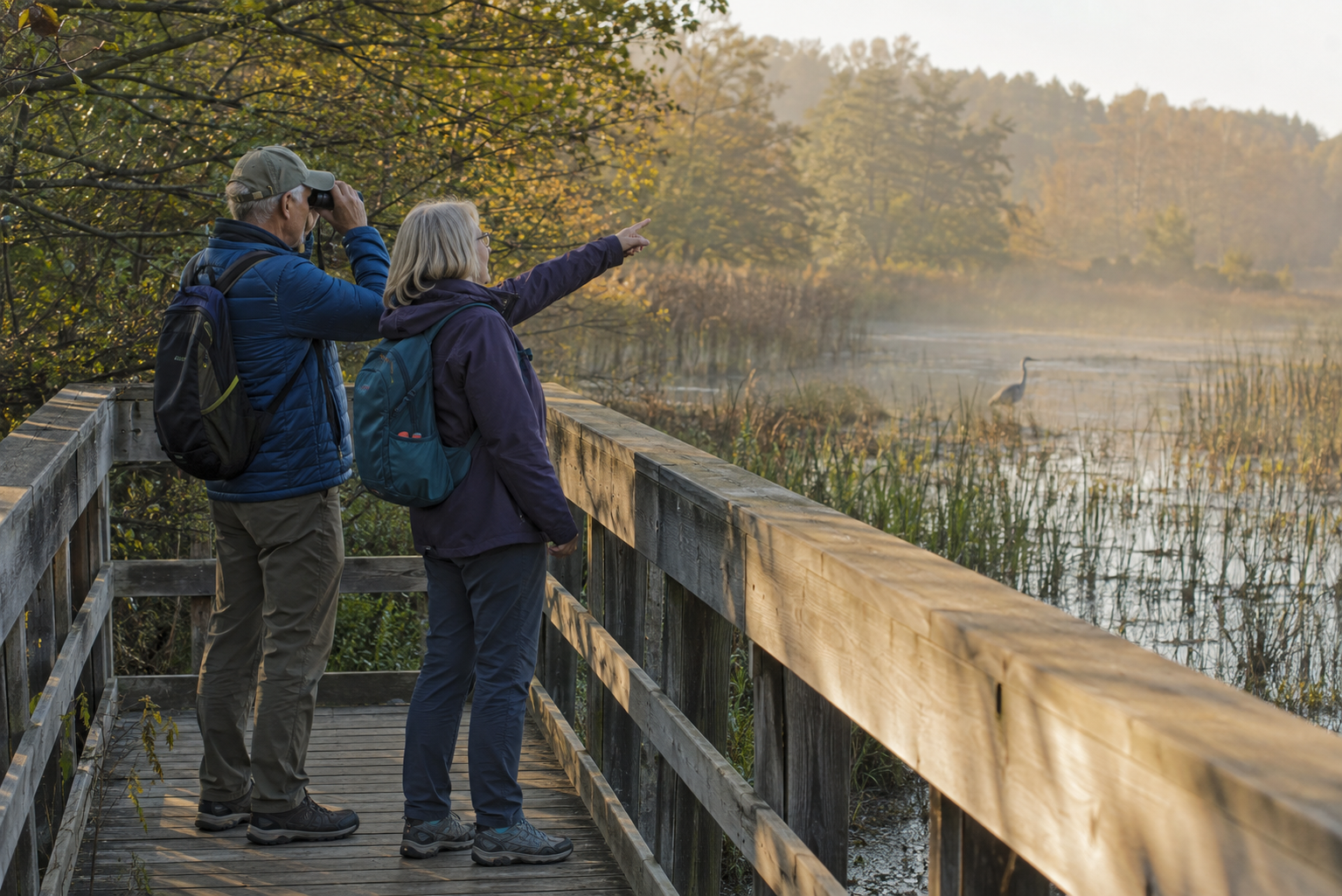
It often begins with one small interruption: a flash of red in the hedge, a shape circling above the highway or a song you have heard for years without knowing who made it.
Then you look properly. The red becomes a Northern Cardinal. The silhouette becomes a Red-tailed Hawk. The familiar whistle belongs to a White-throated Sparrow. Suddenly, an ordinary walk has a plot.
That is birdwatching’s quiet magic. It asks very little at the beginning, yet it can grow into a lifelong practice of observation, learning, friendship, conservation and travel.
Why birding fits this stage of life
Birdwatching can be as restful or adventurous as you want it to be. You can watch a feeder from the kitchen table, stroll a flat boardwalk with friends or plan an expedition around a species found nowhere else on Earth.
It encourages gentle movement and time outdoors, but the deepest reward is attention. Birders learn to slow down, notice patterns and become familiar with the changing seasons close to home.
Research is encouraging without turning birding into a medical prescription. A 2026 scoping review of 196 studies found repeated associations between encounters with birds and mental health, well-being and connection to nature. That does not prove birdwatching treats a condition—but it supports what many birders already feel: noticing birds can make a day richer.
Start this week: one easy outing
- Choose a familiar place: your backyard, a neighbourhood pond, a local park or an accessible wetland boardwalk.
- Go early in the morning for 20–30 minutes, when many birds are active and the day is still quiet.
- Look first with your eyes. Notice movement, then raise the binoculars without looking away from the bird.
- Describe what you observed before reaching for a name: size, shape, colour pattern, behaviour, habitat and sound.
- Record three birds in a notebook or app—even if one remains “small brown bird.” Curiosity counts before certainty.
Buy binoculars slowly
You do not need premium optics to begin. Borrow a pair, attend a club walk or test several models in person before buying. Comfort matters more than a famous name.
For most beginners, 8×42 binoculars are the reliable all-round choice: eight-times magnification is easier to hold steady and a 42 mm objective gathers useful light. A lighter 8×32 pair may be more comfortable for smaller hands, neck or shoulder concerns and travel.
- Check that you can reach the focus wheel naturally with one finger.
- If you wear glasses, test whether you can see the full circular image with the eyecups lowered.
- Choose a weight you will happily carry for an hour—not merely tolerate in the store.
- Look for waterproof or weather-resistant construction and a comfortable strap or harness.
- Avoid choosing 10× or 12× magnification simply because the number is larger; a narrower, shakier view can make finding birds harder.
A realistic Canadian starter budget
Birding can remain inexpensive because the birds, trails and two best digital tools are free. Prices below are broad Canadian-dollar estimates checked in September 2026.
- Borrowed binoculars plus free apps: almost no cost.
- Dependable starter binoculars: roughly $150–$300.
- Mid-range binoculars with brighter optics and smoother handling: roughly $300–$800.
- Paper field guide or weatherproof notebook: about $20–$45.
- Binocular harness, small daypack or compact seat: approximately $30–$100 each.
- Spotting scope and tripod for distant shorebirds or waterfowl: often $500–$1,500 or more—and unnecessary at the beginning.
- Premium optics, cameras and guided travel can cost thousands, but none is required to become an excellent birder.
Learn birds through six clues
Identification becomes much easier when you stop asking only, “What colour was it?” Colour changes with light, distance, age and season. Build a short description instead.
- Size: Was it closer to a chickadee, robin, crow or goose?
- Shape: Notice the bill, tail, wings, neck, legs and posture.
- Pattern: Look for wing bars, eye rings, streaking, patches or a contrasting cap.
- Behaviour: Did it hop, climb a trunk, hover, bob its tail, dive or soar?
- Habitat: A marsh, conifer forest, open field and rocky shoreline suggest different possibilities.
- Sound: Rhythm and quality often matter more than trying to spell the song.
Let technology help—not decide
The free Merlin Bird ID app from the Cornell Lab can suggest birds from a description, photograph or sound recording. It is a remarkable learning companion, especially for songs, but its answer is still a suggestion. Confirm it against the bird’s appearance, range, season and behaviour.
eBird lets you keep lists, explore nearby hotspots and contribute observations used in research and conservation. Beginners should favour accurate, modest checklists over impressive totals. If you are uncertain, leave the bird unidentified or add notes rather than forcing a name.
The next stage: habitats, seasons and songs
Once the common birds become familiar, vary the habitat. Visit a woodlot one week, a marsh the next and a shoreline after that. Return through the seasons and the same place will feel entirely new.
Learn a few voices at a time. Begin with birds you hear near home, comparing the live sound with trusted recordings. Migration forecasts and recent eBird reports can help choose when and where to go, but discovery is more satisfying when the outing is not reduced to chasing someone else’s pin on a map.
- Keep a life list if it motivates you, but also try yard, county, seasonal or “patch” lists.
- Study one bird family at a time—woodpeckers, sparrows, ducks or hawks.
- Join a guided walk and listen to how experienced birders describe what they notice.
- Try sketching behaviour or habitat instead of collecting only names.
- Add a spotting scope only when distant birds regularly limit your outings.
Turn observations into something useful
Birding can become a genuine contribution to science. Birds Canada offers community programs including eBird Canada, Project FeederWatch, the Christmas Bird Count and breeding-bird atlases.
Project FeederWatch is especially approachable: participants count birds visiting a chosen location during the November-to-April season. It works from a home, nature centre or community space, making it useful when travel or mobility is limited.
As skills develop, opportunities expand into migration monitoring, habitat restoration, nest projects and organized counts. The hobby gains another layer when a morning’s observations help reveal how populations are changing.
Good birding puts the bird first
The best view is never worth stressing a bird or damaging its habitat. The American Birding Association’s ethics code is a practical standard wherever you travel.
- Keep a respectful distance, especially from nests, colonies, roosts and feeding sites.
- Limit recordings used to attract birds; repeated playback can disrupt feeding, breeding and territory defence.
- Stay on designated trails and respect closures, private property and other visitors.
- Use a longer lens rather than moving closer for a photograph.
- Do not publish the precise location of a sensitive nest or vulnerable species.
- Share space generously. Not everyone on a trail wants a crowd or a whispered identification lesson.
Make the hobby fit your body
Birding does not have to mean long hikes or rough terrain. Stationary observation, short loops, accessible boardwalks, viewing platforms and vehicle-based routes where permitted can be just as rewarding.
- Choose supportive footwear and bring trekking poles if they improve confidence.
- Use a binocular harness to move weight from the neck to the shoulders and torso.
- Carry water, medication, sun protection, insect repellent and a light layer.
- Check trail surface, washroom access, benches and parking before leaving.
- Tell someone your route when birding alone and remain aware of weather, ticks and uneven ground.
- If vision, hearing, balance or joint concerns affect the outing, adapt the method rather than giving up the hobby.
Excellent places to begin in Ontario
Start close enough that you can return often. Familiarity teaches more than constantly visiting new places.
- Your own neighbourhood: cardinals, chickadees, woodpeckers, robins, sparrows and seasonal visitors.
- Rouge National Urban Park: forests, meadows, farmland, wetlands and shoreline within reach of the Greater Toronto Area.
- Tommy Thompson Park: an urban shoreline stopover with waterbirds, raptors and migrating songbirds.
- Point Pelee National Park: one of Canada’s celebrated spring migration destinations, with more than 390 species recorded.
- Long Point and the north shore of Lake Erie: globally important migration habitat and home to Birds Canada’s Long Point Bird Observatory.
- Presqu’ile Provincial Park and Carden Alvar: strong seasonal birding in very different habitats.
When birding becomes a reason to travel
A birding trip gives travel a purpose beyond sightseeing. Guides can reveal wildlife you would never find alone, while a slower itinerary leaves time to observe rather than rush.
Within Canada, consider Grasslands National Park for prairie specialists, British Columbia’s Fraser River delta and Gulf Islands, the Bay of Fundy for shorebird migration, and Newfoundland for seabird colonies. Abroad, Costa Rica and Belize offer comfortable tropical introductions; Spain and Portugal combine migration, wetlands and culture; Ecuador and Peru reward experienced travellers with extraordinary diversity.
Before booking, ask about walking distances, terrain, heat, early starts, washroom access, group size and how much time is spent in vehicles. “Senior-friendly” is too vague; the daily routine is what determines whether a trip feels exciting or exhausting.
The B Side verdict
Birdwatching is one of those rare hobbies that makes your existing life more interesting before it asks you to build a new one. The backyard changes. The drive to the cottage changes. A morning walk becomes an expedition measured in attention rather than distance.
Begin with twenty minutes and three birds. Learn their names, then their voices, then when they arrive and leave. Before long, the world outside the window will no longer look like background scenery. It will feel alive with stories.