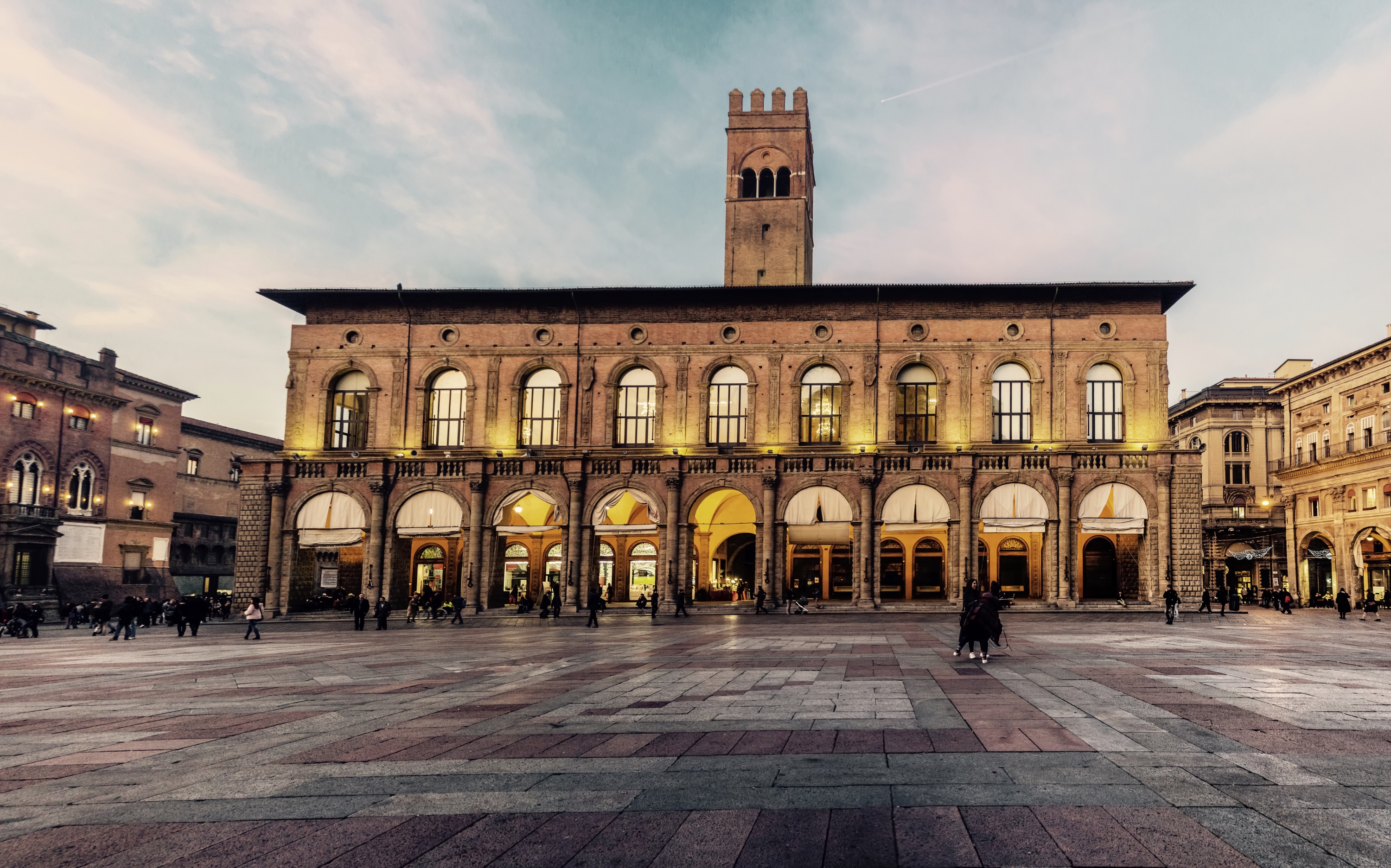
By late morning, Bologna is beginning to smell like lunch.
Beneath a brick portico, a man finishes an espresso at the counter. A bicycle rattles past. Through the window of a pasta shop, someone rolls a sheet of yellow dough across a wooden board, lifting and turning it with the ease of long practice.
You stop to watch. A few minutes later, you’re still there.
The church you meant to visit can wait.
Bologna rewards this sort of delay. There are important buildings, fine museums and centuries of history to explore, but much of the pleasure lies between the sights: a sheltered walk in the rain, a market stall worth returning to, a lunch that quietly takes over the afternoon.
It’s a busy university city, with deliveries to make, lectures to attend and people trying to get home. That ordinary life is part of its appeal. Stay long enough and you begin to find your place around it.
You learn where to buy bread. You develop an opinion about the coffee. One evening, you walk back from Piazza Maggiore without checking your phone.
That small familiarity is what makes Bologna such a satisfying place to spend a few weeks.
📍 Why Bologna deserves a longer stay
Bologna is the capital of Emilia-Romagna, a region whose contribution to dinner includes Parmigiano Reggiano, Prosciutto di Parma, traditional balsamic vinegar, mortadella and several excellent reasons to eat fresh pasta.
You could come for the food alone and have a thoroughly worthwhile trip.
But there’s more here than a succession of good lunches. The university brings students into the medieval streets, keeping the city lively. Bookshops, cafés and neighbourhood businesses give you somewhere to go when you’ve had enough sightseeing.
Then there are the porticoes: roughly 62 kilometres of covered walkways across Bologna, with about 40 kilometres in the historic centre. They give the streets much of their character and make walking easier in both rain and strong sun.
After a few days, you stop thinking of them as an architectural feature. You simply appreciate being able to get to the market without arriving soaked.
Bologna also makes a useful railway base. Florence is about 35–40 minutes away on a fast service, while some trains reach Rome in roughly two hours. Milan and Venice are also connected by high-speed rail. Check individual services before planning your day.
For a longer trip, that means you can unpack once and explore from somewhere familiar. There’s a particular pleasure in returning after a day away and knowing exactly how to get home—and where to pick up dinner on the way.
🌤️ When to go
Bologna sits in the Po Valley. Expect hot, humid summers and winters that can feel chilly and damp.
For a stay built around walking, markets and occasional train trips, spring and early autumn are the most appealing choices.
April and May: time to wander
Spring brings greener countryside and more comfortable conditions for long walks. You’ll want a light jacket and something waterproof, but a rainy afternoon needn’t ruin your plans.
It can become a museum afternoon. Or a longer lunch.
June: choose the earlier weeks
Early June can be lovely. As the month progresses, heat becomes more of a consideration, especially if you’re planning to spend most of each day outside.
An apartment with reliable air conditioning gives you somewhere comfortable to retreat.
July and August: plan around the heat
These are less appealing months for an extended walking holiday. Sightseeing is better done early, with quieter afternoons and evenings outside once the temperature eases.
Some independent businesses also take summer breaks, particularly in August. Check opening dates if there’s a restaurant or shop you especially want to visit.
September and October: my choice for a month
The prospect of cooler walks, autumn produce and tortellini in broth makes this an easy season to favour.
I’d look first at mid-September through mid-October, while allowing for warm days and wet ones. You’re still visiting a working city, so it doesn’t depend on perfect weather to be enjoyable.
November to March: a different sort of stay
Winter Bologna asks for a warmer coat and more indoor plans. Cafés, galleries, churches and lunches become a larger part of the day.
If your idea of Italy includes reading in a café while rain falls outside, there’s something to work with here.
💰 What should you budget?
Food may be Bologna’s great attraction, but accommodation is likely to decide what your trip costs.
Be careful with monthly rent figures. A standard residential lease and a furnished apartment available to a visitor for four weeks are different products. A low long-term rent tells you little about what will be available for your dates.
For an initial travel budget, the following ranges are useful starting points rather than confirmed prices:
| Expense | Working allowance |
|---|---|
| Simple guesthouse or hotel | €80–€120 per night |
| Comfortable mid-range hotel | €120–€190 per night |
| Boutique or upscale hotel | €190–€300+ per night |
| Simple lunch | €12–€20 per person |
| Trattoria dinner | €25–€40 per person |
| Espresso at the counter | Around €1–€2 |
Accommodation can rise considerably during busy periods. Price the actual stay before committing to flights.
For local buses, TPER’s published urban contactless fare is €2.30, with caps of €9 per day and €25 over seven days under its contactless system. Follow the operator’s instructions when using it.
An apartment lets you balance restaurant meals with shopping and cooking. In Bologna, that needn’t feel like economizing. Fresh pasta, good tomatoes, bread and cheese can make staying in one of the better evenings of the week.
🏡 Could Bologna suit retirement?
It’s easy to see the appeal: a walkable centre, culture, rail connections and enough everyday activity to keep the city interesting beyond a holiday.
But enjoying two weeks somewhere and wanting to live there are different things.
A longer stay lets you test the less photogenic parts. Can you find an apartment you’re comfortable in? Do you enjoy the neighbourhood on a wet Tuesday? How do you feel about the noise, the stairs, the language and the summer heat?
For Canadians, a month is a relatively straightforward experiment. Canadian citizens can generally visit the Schengen Area without a visa for up to 90 days in any 180-day period; that allowance covers time across Schengen countries, not Italy alone. Longer residence requires the appropriate arrangements.
Start with ordinary life. Buy groceries, do laundry, take the bus and try arranging a haircut.
Those experiences will tell you more about living in Bologna than another afternoon looking at property listings.
🍝 What to eat—and why it matters here
Bologna’s food traditions become more interesting when you give them some attention. Order a few local dishes, visit a pasta shop and ask questions when there’s time.
You don’t need to turn every meal into homework. Curiosity is enough.
Tagliatelle al ragù
Look for tagliatelle rather than expecting the spaghetti Bolognese familiar from menus back home.
The broad egg pasta carries the meat sauce beautifully. A good plate feels rich and satisfying without needing to be buried beneath sauce.
Eat slowly enough to notice the pasta itself.
Tortellini in brodo
Small filled pasta in broth sounds modest on paper. On a cool day, it can be exactly the meal you want.
Bologna takes its tortellini seriously: the filling and the classic recipe have been formally registered with the local Chamber of Commerce.
Fortunately, enjoying them requires no knowledge of the paperwork.
Mortadella
Try it thinly sliced, perhaps tucked into fresh bread. Its delicate texture and seasoning deserve a little attention before you add anything else.
A mortadella sandwich is also a useful reminder that lunch doesn’t always require a reservation.
Fresh pasta from a neighbourhood shop
Watch a sfoglina, a traditional pasta maker, at work if you have the chance. The rolling, cutting and folding reveal how much skill sits behind a seemingly simple plate.
If your apartment has a kitchen, buy some pasta to take home. Ask how to cook it and what to serve with it. You may leave with dinner and a short lesson.
🧭 Seven experiences worth taking slowly
1. Walk beneath the porticoes
Choose a direction rather than a packed itinerary.
Via Santo Stefano, Strada Maggiore and Via Saragozza offer plenty to hold your attention: changing light, shop windows, doorways and the life moving around you.
Stop when something interests you. There’s no need to turn a pleasant walk into a distance target.
2. Follow the covered route to San Luca
The Sanctuary of the Madonna di San Luca stands above the city, connected to it by a long portico running from Porta Saragozza. The route stretches roughly four kilometres and includes more than 600 arches.
This is a proper uphill outing. Allow time, carry water and pause when you want to.
The walk is as much a reason to go as the arrival.
3. Shop as though you have dinner to make
Enjoy the old food shops of the Quadrilatero, then explore Mercato delle Erbe and businesses near your apartment.
Buy what looks good rather than arriving with a complicated recipe. A few vegetables, fresh pasta, bread and cheese will usually give you somewhere to start.
By the second week, you may be returning to a stall because you liked what you bought last time. That’s a small but satisfying change from browsing.
4. Take a pasta-making lesson
You may never become someone who makes tortellini on a weekday. A lesson is worthwhile anyway.
Working with the dough gives you a better appreciation of the people who do it well. You’ll notice things at your next lunch that you might previously have missed.
And you get to eat what you’ve learned.
5. Return to Piazza Maggiore
See it in the morning, when the day is getting started. Pass through in the afternoon. Come back in the evening.
Repeated visits reveal more than a single stop with a camera. Eventually, you’ll have a favourite place to sit.
6. Spend a day in Modena or Parma
Both make appealing excursions for anyone interested in food, handsome streets and a change of pace.
Choose one and give it the day. Allow time for lunch and an unplanned walk.
Combining both may be possible, but it would leave you with less time in either.
7. Visit somewhere famous, then return home
A day in Florence can fit comfortably into a Bologna stay. Venice or Milan may appeal too, depending on how much travel you enjoy. Rome is reachable, though the return journey makes for a longer outing.
Consider the whole day, including getting to stations and moving around at the other end.
The reward is coming back to your own apartment, leaving your shoes by the door and having no further arrangements to make.
⭐ The moments you may remember
Some of the best memories are likely to arrive without much planning.
A pasta maker folding tortellini while continuing a conversation. The shade beneath the arches on a warm afternoon. A bowl of broth when the weather turns grey.
Perhaps you’ll remember an evening train ride after a day in Florence, when you realize you’re looking forward to getting back to Bologna.
Or a lunch that runs so long you quietly abandon the afternoon’s plans.
None of these needs to become a life lesson. They’re simply good reasons to stay.
❤️ An ordinary day, three weeks in
Imagine you’ve been here long enough to have a routine.
At half past eight, you walk to the café you’ve started using. You order an espresso and a cornetto at the counter. The exchange is familiar now, even if your Italian still needs patience.
You buy vegetables on the way home, then head out to see a church you’ve been meaning to visit.
Lunch is tagliatelle. Afterward, you read for a while before walking through the university district.
By early evening, you’re ready for an aperitivo. You’d planned to cook, but a plate of mortadella arrives at a neighbouring table and your resolve weakens.
You’ve seen one church, done a little shopping and spent much of the day on foot. There’s no impressive list of accomplishments.
Still, you’ve had a full day. Tomorrow can be different—or much the same.
That freedom is a large part of the attraction.
⚖️ The pleasures and the compromises
Food is the obvious strength, but Bologna’s usefulness matters just as much. You can build a satisfying day around walking, shopping, culture and meals without needing a car or a succession of major attractions.
Its university and working population keep everyday life visible. That brings energy, along with noise and crowds in some areas.
Housing is the main difficulty. Finding a furnished apartment that suits your dates, budget and needs may take persistence. Beautiful photographs won’t tell you whether the street is noisy or the bedroom gets unbearably warm.
Summer heat deserves attention. Ask directly about air conditioning rather than assuming it’s included.
Older buildings involve trade-offs. Check the floor, lift access, heating and bathroom layout. A handsome staircase is still a staircase when you’re carrying groceries.
Some Italian will help. You can manage many visitor situations in English, but ordinary exchanges become easier with a few useful phrases. Being able to ask a question at a market—or explain what sort of haircut you want—adds something to the stay.
🏡 Could I actually stay here for a month?
Yes—especially if your priorities are food, walking and train travel.
Bologna is less suited to someone seeking beaches or a quiet resort atmosphere. Its appeal is having a city to live in for a while.
Where to look
Begin by comparing apartments around Santo Stefano, Saragozza, Murri and the edges of the historic centre.
Judge the specific address rather than the neighbourhood name alone. Look at the walk to groceries, the bus connections, nearby nightlife and the distance to the station if you expect frequent day trips.
For accommodation, prioritize:
- A kitchen you’ll comfortably use.
- A quiet bedroom.
- Air conditioning or adequate heating for your season.
- A lift if stairs would limit your enjoyment.
- Reliable Wi-Fi.
- Clear information about fees, utilities and cancellation.
What a month for two might cost
The figures below are a planning allowance, not a verified quote. The apartment is the largest uncertainty, and a suitable short stay may cost more than this range.
| Expense | Working monthly budget |
|---|---|
| Furnished apartment | €1,200–€1,800+ |
| Groceries | €400–€550 |
| Restaurants and cafés | €400–€650 |
| Local transport and selected day trips | €100–€250 |
| Activities and experiences | €200–€400 |
| Phone, utilities and miscellaneous costs | €150–€300 |
| Illustrative total | €2,450–€3,950+ |
This excludes flights, travel medical insurance and any accommodation fees or taxes not included in the quoted rent.
The lower end calls for reasonably priced accommodation, regular cooking and selective outings. Several high-speed rail trips or frequent restaurant dinners can move the total upward quickly.
Daily practicalities
You may have little need for a car. Walking and local transport can cover an urban routine; rent a vehicle for a particular countryside outing if it makes sense.
Check the apartment’s internet before booking, especially if you’ll rely on video calls. Ask about laundry too. These details matter more in week three than they do on arrival.
Arrange travel medical insurance that suits your health and plans. Having hospitals nearby doesn’t settle what your policy will cover.
What might wear thin?
Apartment hunting, noisy streets, hot nights or winter damp.
A month gives you enough time to encounter the irritations as well as the pleasures. That’s useful if you’re considering longer stays—or simply trying to work out what kind of travel suits you now.
🧳 Is Bologna worth it?
Bologna makes a strong case for travellers who enjoy having time to settle somewhere.
You can eat well, explore on foot, take occasional trips and leave room for afternoons that don’t need explaining. The city offers plenty to see without requiring every day to revolve around sightseeing.
After a few weeks, you’ll probably have a preferred café and a reliable place to buy dinner. You’ll know which route you like home. Some of the streets that seemed remarkable on arrival will become familiar, though no less pleasurable.
That’s what I’d come for.
And if the most pressing question one afternoon is whether to order tortellini or tagliatelle, it seems reasonable to give the decision your full attention.
🌍 If Bologna appeals to you, consider…
Parma, for a smaller city with a strong food identity and a gentler pace.
Turin, for arcades, cafés, museums and a different view of northern Italian life.
Lyon, for markets, neighbourhood restaurants and another city where good eating fits naturally into an ordinary day.
Bologna’s particular appeal is how easily you can imagine those ordinary days becoming your own.
A month gives you time to find out.