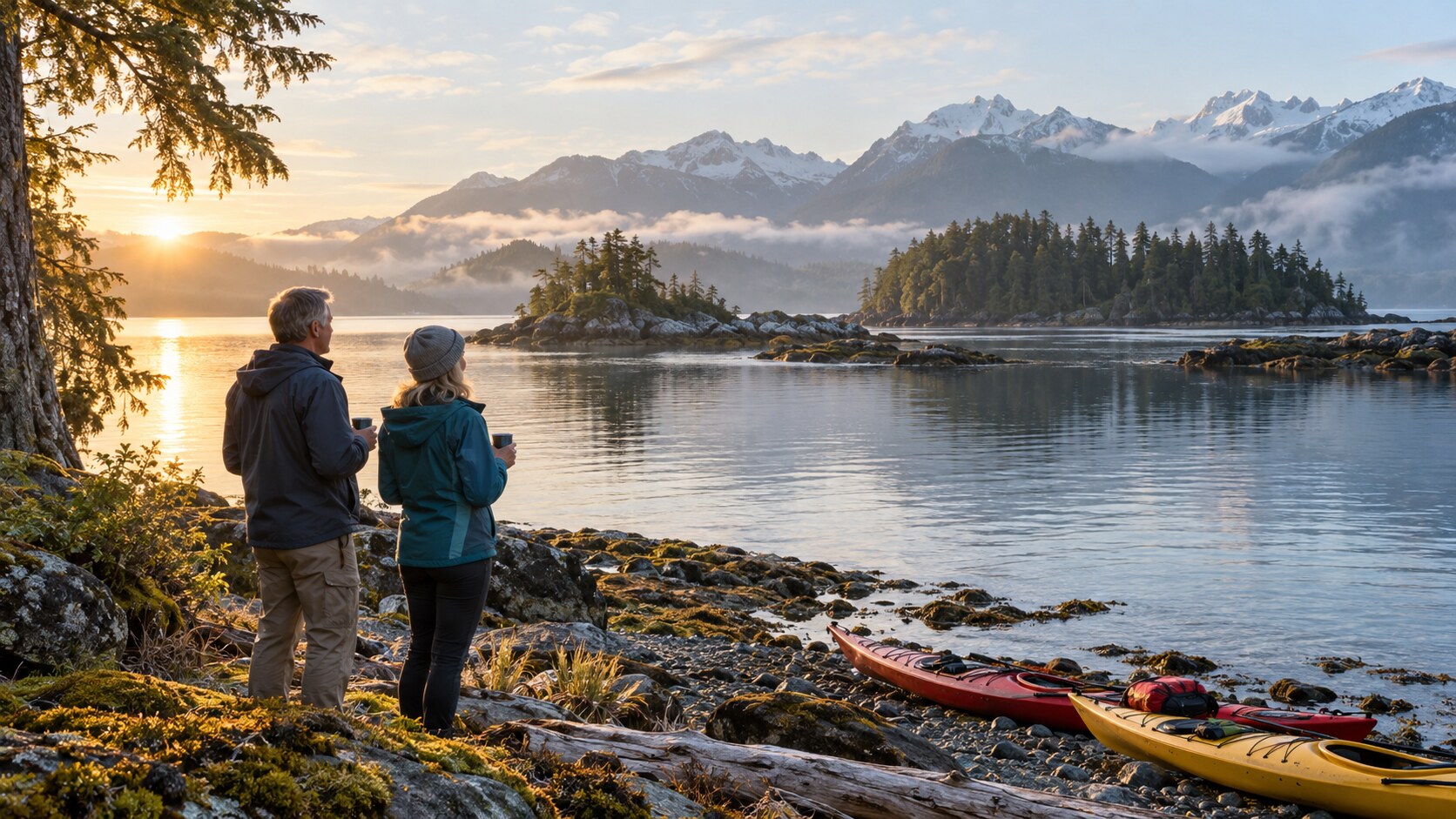
There is a particular kind of morning on British Columbia’s coast: fog resting low over the water, a heron standing motionless at the tideline and snow-capped peaks appearing as the light strengthens. An hour later, you might be walking through old-growth rainforest or drinking coffee beside a vineyard with mountains behind it.
Few places gather ocean, rainforest, dry interior valleys, islands and alpine country into one province. That range is exactly why British Columbia rewards travellers over 50—and exactly why trying to see all of it at once is such a mistake.
This guide is for a more satisfying trip: fewer bases, longer stays, honest driving days and experiences chosen for genuine interest rather than a checklist.
British Columbia does not reward speed. Its best moments usually arrive in the pauses.
First, understand the scale
British Columbia covers almost 950,000 square kilometres. Vancouver to Whistler is an easy road trip; Vancouver to Tofino involves a ferry and a winding island highway; Vancouver to Prince Rupert is a journey of more than 1,500 kilometres. The Rockies, north coast and Haida Gwaii belong in dedicated trips, not as casual additions to a Vancouver holiday.
Vancouver International Airport is the main gateway. Victoria works beautifully for an island-centred journey, while Kelowna lets you begin directly in wine and lake country. Vancouver and central Victoria can be enjoyed without a car; most other regions become much easier with one.
- The golden rule: choose no more than two or three regions in ten days.
- Stay two to four nights per base and use short day trips instead of changing hotels nightly.
- Treat ferry crossings and scenic roads as part of the holiday—not dead time between attractions.
- Leave one unscheduled day for weather, energy or the place you unexpectedly love.
Choose the British Columbia that fits you
- Vancouver — 2–4 nights: Stanley Park, Granville Island, the Museum of Anthropology, gardens and one of Canada’s best food cities. No car is needed downtown.
- Victoria and the Saanich Peninsula — 2–3 nights: harbour walks, history and gardens at a gentler pace. Government House Gardens offers a peaceful, free alternative or complement to Butchart Gardens.
- Tofino and Ucluelet — 3–4 nights: Pacific beaches, rainforest, whale tours and storm-watching. Ucluelet’s Wild Pacific Trail is a rewarding, often quieter base.
- The Gulf Islands — 2–3 nights: art studios, farm stands, kayaking and slow village days. Pick one island rather than racing between several ferry schedules.
- Whistler and Sea-to-Sky — 2–3 nights: gondola views, lake walks and an alpine village that works even if skiing or demanding hiking does not interest you.
- The Sunshine Coast — 2–4 nights: Gibsons, Sechelt and sheltered-water paddling with fewer crowds than better-known coastal stops.
- The Okanagan — 3–5 nights: wineries, orchards, warm lakes, golf and gentle rail-trail cycling. Naramata and Penticton often feel calmer than central Kelowna.
- The Kootenays — 3–5 nights: Nelson, Kootenay Lake and hot springs in a region where mountain-town character matters more than polished resort spectacle.
- Yoho, Kootenay, Glacier and Mount Revelstoke national parks — 3–5 nights: alpine lakes, waterfalls and dramatic drives, best treated as a Rockies trip rather than combined with Vancouver Island.
- Cariboo Chilcotin Coast — a dedicated road trip: ranch country, lakes, Barkerville and wide-open spaces for travellers who genuinely enjoy remoteness.
- Northern BC and Prince Rupert — a dedicated journey: long distances, wildlife and coastal culture with far fewer visitors and fewer services.
- Haida Gwaii — at least 4–6 nights: ancient forests and living Haida culture. Plan well ahead and favour Haida-led experiences, especially for culturally sensitive places and Gwaii Haanas.
For a first trip, Vancouver plus Victoria and one island or west-coast base gives the richest balance with the least logistical strain.
When to go
Coastal BC and the interior behave like different countries. Vancouver and Victoria are mild and wet through much of winter; Tofino is wetter and windier; the Okanagan is hot and dry in summer; mountain weather can turn cool in any month. Pack layers, a genuinely waterproof shell and broken-in shoes with reliable tread.
Wildfire and smoke conditions change from year to year. Check the BC Wildfire Service, air-quality advisories and DriveBC before a summer road trip, then keep one flexible day in the plan.
- May: A strong shoulder-season choice on the coast—mild, green and less crowded. High mountain trails may still be snow-covered.
- June: Long daylight and generally pleasant conditions before the busiest holiday weeks. One of the best all-round months.
- July and August: The warmest, driest coastal weather and full mountain access, but also peak prices, ferry demand and wildfire-smoke risk in some years.
- September: Often the sweet spot—warm days, easier reservations, Okanagan harvest season and fewer families travelling after school resumes.
- October: Beautiful in the interior and increasingly wet on the coast. Winter-tire rules begin on many highways October 1.
- November through March: Excellent for skiing, hot springs and storm-watching, but coastal rain, short days and winter driving change the nature of the trip.
- April: Blossoms and mild city days can be lovely, while alpine recreation remains wintry and weather stays changeable.
Four itineraries that leave room to breathe
A lower-activity trip can be just as memorable: Vancouver’s seawall and gardens, a scenic ferry crossing, Victoria’s harbour, Butchart Gardens, an accessible whale-watching vessel and a quiet Gulf Island stay. Ask operators about boarding steps, enclosed cabins, washrooms and mobility assistance before reserving.
- Seven days — Vancouver and Victoria: three nights in Vancouver, ferry to Victoria, three nights around the Inner Harbour and Saanich Peninsula, then depart from Victoria or return to Vancouver.
- Ten days — Vancouver, Victoria and the wild coast: three nights Vancouver, three Victoria, then three or four nights in Ucluelet or Tofino. Do not schedule a flight immediately after the return drive and ferry.
- Ten days — Vancouver, Whistler and the Okanagan: two nights Vancouver, two or three Whistler, then four or five around Kelowna, Naramata or Penticton. Consider flying home from Kelowna to avoid backtracking.
- Fourteen days — a slower coastal journey: three nights Vancouver, two Sunshine Coast, three Victoria or Cowichan Valley, four Ucluelet or Tofino and a final night near the departure airport.
What the trip really costs
British Columbia is not a bargain destination. Vancouver, Whistler and Tofino can be especially expensive in summer, while the Kootenays, Cariboo and smaller interior towns often offer better value. These September 2026 ranges are planning estimates for two adults, before flights to BC.
- Value-conscious: roughly C$250–C$400 a day for accommodation, food and modest activities, before a rental vehicle.
- Comfortable mid-range: roughly C$450–C$750 a day, before flights, with well-located lodging, restaurant meals and selected paid experiences.
- Rental vehicle: commonly C$75–C$140 a day once basic coverage and taxes are considered; larger vehicles and peak dates cost more.
- Ferries: price the exact route, passengers, vehicle length and reservation through BC Ferries. Vehicle fares—not food or accommodation—often make an island day more expensive than expected.
- Ten days for two: a useful mid-range starting estimate is C$5,000–C$8,500 before flights, depending heavily on hotels and vehicle days.
- Fourteen days for two: begin around C$7,000–C$12,000 before flights, then price the actual dates rather than relying on averages.
The easiest way to save without shrinking the experience is to travel in June or September and move less often.
Ferries, roads and the details that can derail a day
- Reserve popular vehicle sailings in summer. Arrive within the check-in window printed on the booking; a reservation is not permission to arrive at departure time.
- BC Ferries’ seniors discount is for qualifying British Columbia residents aged 65 and over, generally on passenger fares Monday through Thursday except holidays. It does not make the vehicle free, and an Ontario visitor should not expect to qualify.
- Winter tires or chains are required on most designated BC routes from October 1 through March 31; some highways keep the requirement through April 30. Confirm your exact route and rental vehicle rather than relying on a general promise of ‘all-season’ tires.
- Highway 4 to Tofino is winding. The Sea-to-Sky, Coquihalla and mountain park roads deserve daylight, reasonable weather and time beyond the navigation estimate.
- Fuel and cellular service can be far apart in remote areas. Download offline maps, refill before the tank becomes a concern and check DriveBC before longer drives.
- A short regional flight can save a day. Price Vancouver–Kelowna or Vancouver–Prince Rupert against a one-way rental and the value of your time.
Big experiences without a punishing hike
- Walk or cycle part of Stanley Park’s seawall instead of treating the full loop as an obligation.
- Ride the Sea to Sky Gondola or Whistler’s mountain lifts and choose a short viewpoint trail at the top.
- Cross to Vancouver Island as a foot passenger and enjoy the Tsawwassen–Swartz Bay sailing as a scenic cruise through the Gulf Islands.
- Use boardwalks and beach access in Pacific Rim National Park Reserve; regular 2026 daily admission is C$12.25 per adult, C$10.75 per senior 65+ or C$24.50 per family/group.
- Book an Okanagan wine tour with a driver, then give one winery enough time to become an experience rather than a tasting-room tally.
- Take a small harbour cruise, garden tour, accessible wildlife excursion or scenic train journey when knees, balance or weather argue against the trail.
Food worth slowing down for
British Columbia’s table begins with the Pacific: wild salmon, halibut, Dungeness crab and a brief spring season of spot prawns. The Okanagan and Similkameen add stone fruit, apples, cherries and wines; Vancouver and Richmond offer exceptional Cantonese, Sichuan, Japanese, Korean and Taiwanese cooking; Vancouver Island contributes farm stands, cider and seafood towns.
Try a Nanaimo bar in Nanaimo, but do not stop at novelty. Visit a farmers’ market in Duncan, Qualicum Beach, Penticton or Nelson; reserve one memorable dinner; and leave space for the unplanned roadside fruit stand that may become the taste you remember most.
In small communities, check opening days and reserve dinner. ‘We’ll find something’ becomes less charming when the kitchen closes at eight.
Wildlife—with wonder and good judgment
Depending on place and season, BC may offer orcas, humpbacks, grey whales, black and grizzly bears, eagles, sea otters, seals, elk and mountain goats. None owes you an appearance. Choose operators who explain viewing distances, changing conditions and what happens if wildlife simply does not arrive.
Go with licensed guides for bear viewing, never feed wildlife and keep food secured. For marine tours, ask about the vessel, exposure, motion, washrooms and warm clothing—not just the advertised species. A responsible encounter is better for animals and usually more meaningful for people.
Travel with respect
Every BC journey takes place on the traditional and unceded or treaty territories of Indigenous Peoples. Indigenous-led tourism—such as cultural centres, guided paddles, food experiences and Haida-led visits—adds context that no roadside plaque can provide while supporting the communities sharing their knowledge.
Places such as the Squamish Lil’wat Cultural Centre, U’mista Cultural Centre and Haida Heritage Centre deserve time, not a hurried photo stop. Follow local guidance, stay away from restricted or sensitive sites and learn the names of the Nations whose lands you are visiting.
Comfort, health and accessibility after 50
- Alternate active days with a slower morning, spa visit, garden or long lunch. Recovery time is part of a good itinerary, not wasted time.
- Ask specific accessibility questions: distance from parking, number of steps, shower style, ferry boarding, trail surface, seating and washroom access.
- Bring prescription medication in original packaging, plus a sensible buffer. Remote communities may not have the pharmacy hours or stock you expect.
- Ontario residents should carry a valid OHIP card. Insured physician and hospital services elsewhere in Canada are generally covered, but ambulance, prescriptions, private rooms and other services may not be. Supplementary travel coverage can fill important gaps.
- International visitors need private medical insurance. Canadians should also review coverage for trip interruption, rental vehicles, evacuation and any higher-risk activity.
- Mountain and ocean conditions can change fast. Match the route or paddle to current ability, dress for the environment and use a qualified guide when local knowledge matters.
Quieter alternatives when the famous places feel full
- Choose Ucluelet instead of central Tofino, then day-trip north for beaches and meals.
- Try Cowichan Valley wineries instead of a full Okanagan journey.
- Stay on Galiano, Mayne or Pender rather than making Salt Spring your automatic choice.
- Explore Nelson and Kootenay Lake when Whistler’s scale and prices do not appeal.
- Walk Rathtrevor or Qualicum Beach for gentle east-coast island scenery without the long Highway 4 drive.
- Visit Vancouver and Victoria in May or late September, and time headline attractions for early morning or late afternoon.
Mistakes that cost time, money or energy
- Trying to combine Vancouver Island, Whistler, the Okanagan and the Rockies in one short trip.
- Treating a ferry like a bridge and building a tight connection around it.
- Underestimating winding roads, construction, weather and stops on scenic highways.
- Booking every day before leaving room for smoke, rain, fatigue or discovery.
- Assuming every beautiful trail is easy, accessible or snow-free because it is summer in Vancouver.
- Leaving valuables visible at trailheads or viewpoints.
- Approaching wildlife, entering sensitive cultural sites without guidance or treating a community as scenery.
- Relying on cellular coverage instead of downloading maps and reservation details.
The B Side verdict
British Columbia suits travellers who want dramatic nature without giving up good meals, comfortable hotels and cities worth exploring. It is particularly rewarding for couples, photographers, paddlers, gardeners, road-trippers and anyone who prefers a beautiful day to a heroic itinerary.
For a first visit, go in June or September. Choose Vancouver and one coastal or island region—or fly straight to Kelowna and build an entirely different lake-and-wine trip. Book the important pieces, then protect enough empty space for the province to surprise you.
The province will still be there for a return visit. Go deep rather than wide, and let one stretch of shoreline, one island or one mountain town become more than a name on the route.
Pick two regions. Stay longer. Take the ferry. Stop for the peaches. That is how British Columbia becomes a memory instead of mileage.