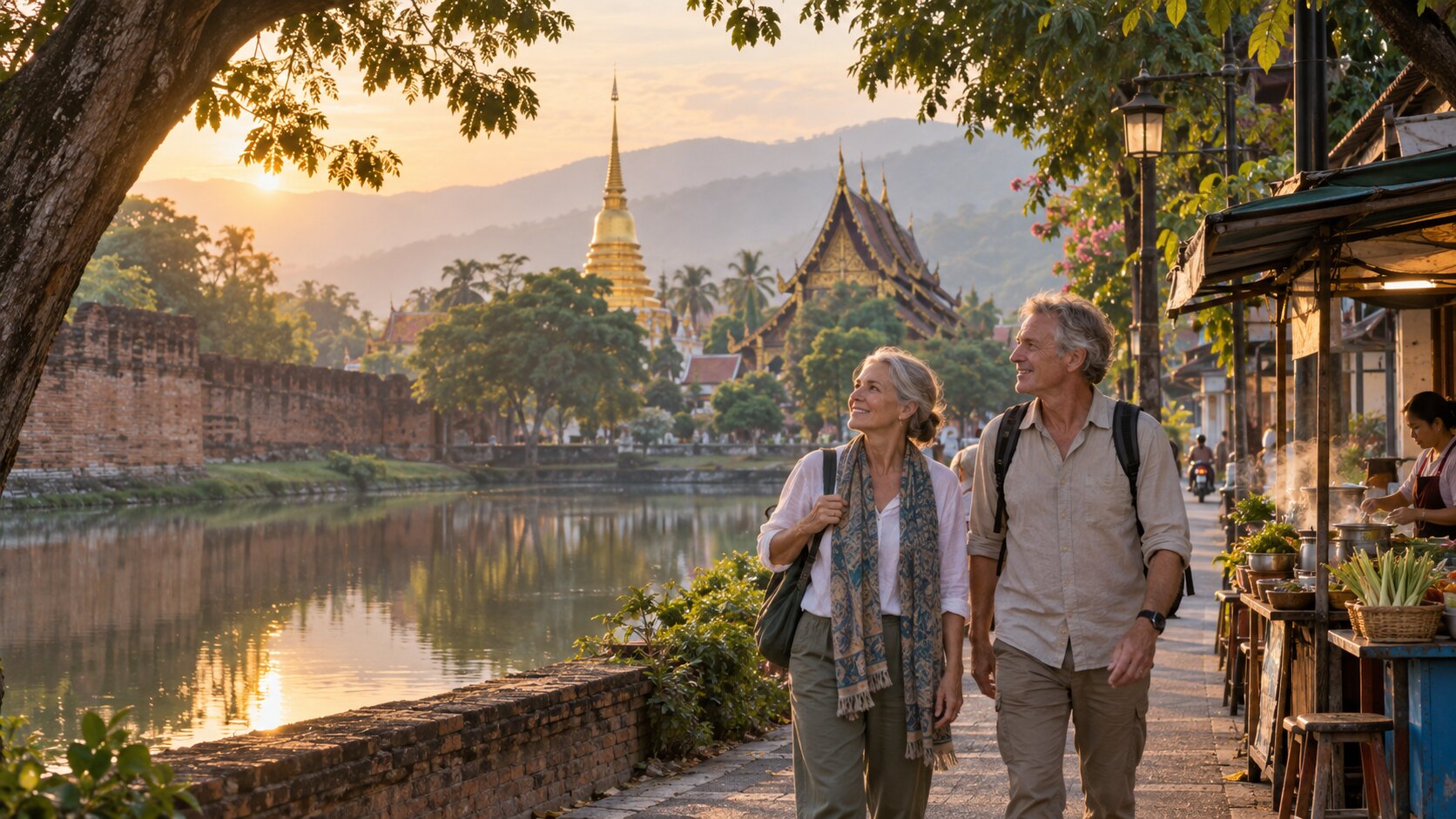
First light arrives softly over the Old City walls, filtering through the rain trees beside the moat. A temple bell sounds once and disappears into the morning. Somewhere nearby, breakfast is beginning: steam rises from a pot, coffee is poured and the scent of lemongrass drifts into the street.
You have nowhere you need to be. The day can unfold at its own pace—perhaps a quiet temple courtyard, a long bowl of khao soi, a shaded café and an evening market. Time, here, does not hurry you.
This is Chiang Mai, northern Thailand’s cultural heart. For travellers over 50 who are tired of racing through checklists, it offers something rarer than another beautiful photograph: the chance to settle in, breathe more deeply and let a place become familiar.
The real luxury of Chiang Mai is not doing everything. It is having enough time to notice where you are.
Why Chiang Mai rewards a longer stay
Founded as the capital of the Lanna Kingdom in the late 13th century, Chiang Mai carries its history in temple roofs, old brick walls, craft traditions and a food culture unlike central Thailand’s. The Old City is compact, forested mountains rise beyond it and the Ping River gives the wider city another easy rhythm to explore.
Unlike a resort built for a week of scheduled entertainment, Chiang Mai becomes more interesting with repetition. Return to the same market. Learn which coffee shop opens early. Notice how a temple courtyard changes between morning and late afternoon. Those small recognitions are the beginning of belonging.
Couples find shared discovery without constant logistics. Solo travellers gain an approachable base with a well-established visitor community. Longer-stay travellers can combine cultural depth, everyday convenience and mountain excursions without changing hotels every second night.
When to go—and when air quality matters
The best planning habit is simple: check Thailand’s official weather and air-quality services close to departure and again each morning. A blue sky is not a reliable measure of fine particles, and conditions can change quickly.
- November through January: Generally the easiest season for outdoor days, with lower humidity, pleasant afternoons and cooler mornings and evenings. This is also popular season, so reserve favourite stays early.
- October and early February: Useful shoulder-season possibilities. Conditions vary from year to year, so check both the forecast and air quality before committing.
- Late February through April: Heat builds and northern Thailand can experience serious smoke and fine-particle pollution from regional burning and wildfires. Timing and severity vary, but travellers with heart or lung concerns should strongly consider another season.
- June through October: The green season brings lush hills, fewer visitors and frequent rain. Showers can be intense but are often episodic rather than a day-long washout. Build flexibility into outdoor plans.
- Mid-April: Songkran is joyful, wet and very busy. Come for the celebration—not for a quiet, predictable week.
For the gentlest first visit, begin with late November, December or January—and pack one light layer for cool mornings.
A seven-day rhythm with room to breathe
If you stay two weeks, do not double the list. Repeat what you loved, add a quiet river day and spend a night or two in the mountains only if moving feels worth it.
- Day 1 — Settle in, circle one section of the moat and eat close to home.
- Day 2 — Visit Wat Phra Singh and Wat Chedi Luang early, then leave the afternoon unscheduled.
- Day 3 — Take a market-led northern Thai cooking class and let that be the whole event.
- Day 4 — Go up Doi Suthep early, adding the forest temple Wat Pha Lat only if the trail and your energy feel right.
- Day 5 — Follow a craft interest: textiles, silverwork, ceramics, umbrellas or contemporary design.
- Day 6 — Choose a carefully vetted wildlife experience, a gentle countryside outing or a driver-led day in the hills.
- Day 7 — Revisit your favourite breakfast, book a massage and wander the Sunday Walking Street if the calendar aligns.
What it costs
For a month-long stay, request a complete written quote that includes electricity, water, cleaning, deposits and cancellation terms. Air-conditioning use can make a meaningful difference.
- Comfortable trip for two: roughly C$160–C$300 a day before international flights, depending heavily on hotel style and excursions.
- Accommodation: simple, well-reviewed stays may begin near C$45–C$75 a night; many comfortable hotels and serviced apartments fall around C$80–C$160; design hotels and resorts can go far higher.
- Food: local noodle shops and markets remain remarkably affordable. Add room for polished restaurants, coffee and the occasional Western meal rather than building the budget entirely around street-food prices.
- Getting around: shared red songthaews and app-based cars are inexpensive for short trips. A private car with driver is worth considering for a comfortable mountain day.
- Experiences: temples are free or inexpensive; massage, cooking classes, guides, parks and responsible wildlife visits deserve their own line in the budget.
Could Chiang Mai become a seasonal home?
Chiang Mai’s apartments, food, private healthcare and established international community make it attractive for stays longer than a holiday. A couple can often create a comfortable local lifestyle for less than in a major Canadian city—but ‘cost of living’ depends on health insurance, housing standard, imported habits, flights home and tax residency as much as it does on noodles and rent.
Thailand offers several long-stay pathways, including retirement-related non-immigrant visas for qualifying applicants aged 50 and older. Financial, insurance, reporting and renewal requirements differ by visa and can change. Tourist status is not a retirement plan, and a visa is not the same thing as tax, healthcare or permanent-residency advice.
At the time of this review, Canadians travelling on a regular passport could generally visit visa-free for up to 60 days and request a discretionary extension of up to 30 more days. Entry rules can change without much notice, so verify the permitted stay before booking a trial month—or three.
Before moving money or signing a lease, confirm the current rules through Thailand’s official e-Visa system or the Royal Thai Embassy responsible for your residence. Then speak with qualified Thai and Canadian advisers about tax residency, provincial health coverage, insurance and estate planning.
Try Chiang Mai for one to three months in two different seasons before deciding whether it belongs in your retirement plan.
A food scene worth slowing down for
Northern Thai cooking is earthy, aromatic and proudly distinct. Meals bring lemongrass, galangal, makrut lime, herbs, fermented flavours and charcoal smoke together without needing ceremony.
Begin with khao soi: egg noodles in a coconut-rich curry broth, finished with crisp noodles, pickled mustard greens, shallot and lime. Try sai ua, the coiled northern sausage fragrant with herbs and spice; nam prik noom, a smoky green-chilli dip; and a shared khan toke meal served on a low round tray.
A cooking class that starts in a market gives context to every bite. Ask about heat levels, allergies and ingredients in advance—especially fish sauce, shrimp paste, peanuts and coconut—and carry a translated allergy card if reactions could be serious.
Do not search for the single ‘best’ bowl of khao soi. Find the one you would happily eat again tomorrow.
Temples, trails and meaningful encounters
- Visit Wat Phra Singh or Wat Chedi Luang near opening time, then sit long enough to see the temple as a living place rather than a backdrop.
- Take a slow ride up to Wat Phra That Doi Suthep. The stairway is substantial; ask about elevator access and plan around heat and crowds.
- Walk a manageable portion of the Monk’s Trail to Wat Pha Lat only in suitable weather, with grippy footwear and enough water.
- Browse a neighbourhood fresh market in the morning and the Sunday Walking Street in the evening, keeping valuables secure in crowds.
- Learn with a local maker through a small textile, ceramics, carving or food workshop.
- Spend an unscheduled hour beside the Ping River or in a shaded courtyard. Rest is not time taken away from the trip.
Choose animal experiences with care
The word ‘sanctuary’ is not a guarantee of good welfare. Avoid venues offering riding, shows, tricks, forced bathing, hugging or constant close-contact photographs. Genuine rescue work gives elephants choice, space and the ability to move away from visitors.
Before booking, look for transparent ownership and rescue histories, small groups, observation-led visits and clear limits on contact. Ask exactly what the day includes. If an operator’s main promise is touching an elephant, keep looking.
The most respectful wildlife memory may be the one where the animal chose not to come closer.
Comfort and safety for travellers over 50
- Traffic moves differently than many Canadian visitors expect. Look both ways, cross patiently and use a ride rather than walking along fast, unshaded roads.
- Old City pavements can be broken, narrow or obstructed. Supportive shoes, a compact day bag and strategic rides protect energy.
- Heat and dehydration arrive quietly. Carry water, plan outdoor time early and choose accommodation with reliable air-conditioning.
- Use mosquito repellent, follow current Canadian travel-health guidance and arrange insurance that covers your conditions and planned activities.
- Read the current Government of Canada travel advisory before departure and before side trips. National risk levels and warnings for particular border regions can change independently of conditions in Chiang Mai city.
- Private hospitals serve international patients, but care is not free. Know where you would go, carry medication in original packaging and keep insurance contacts offline as well as on your phone.
- Treat alms-giving and temple worship as religious practices, not staged attractions. Dress modestly, keep respectful distance and follow local guidance about photography.
The honest balance
What Chiang Mai does beautifully: distinctive food, cultural depth, warm everyday hospitality, good private medical options, mountain access and a daily cost that can leave room for longer stays.
What requires adjustment: seasonal smoke can be severe; heat and humidity are real; pavements are inconsistent; traffic is busy; and English becomes less common outside visitor-oriented places. Long-stay paperwork and insurance also deserve more attention than social media suggests.
It is less suited to travellers who need beach life, polished sidewalks, effortless English everywhere or constant high-energy entertainment. It is wonderfully suited to people who can trade a little predictability for texture, discovery and slower days.
The B Side verdict
Chiang Mai is worth it for travellers who want to inhabit a destination instead of consume it. Come for the temples and mountains, certainly—but stay for the breakfast stall you recognize, the café where the staff remembers your order and the growing ease of knowing which lane leads home.
Pack lightly. Leave several afternoons empty. Check the air, respect the culture and plan a stay long enough for the city to stop feeling like an attraction.
The mountains and temple bells will do the rest.
Arrive curious. Move gently. Let an ordinary Chiang Mai morning become the part you remember most.