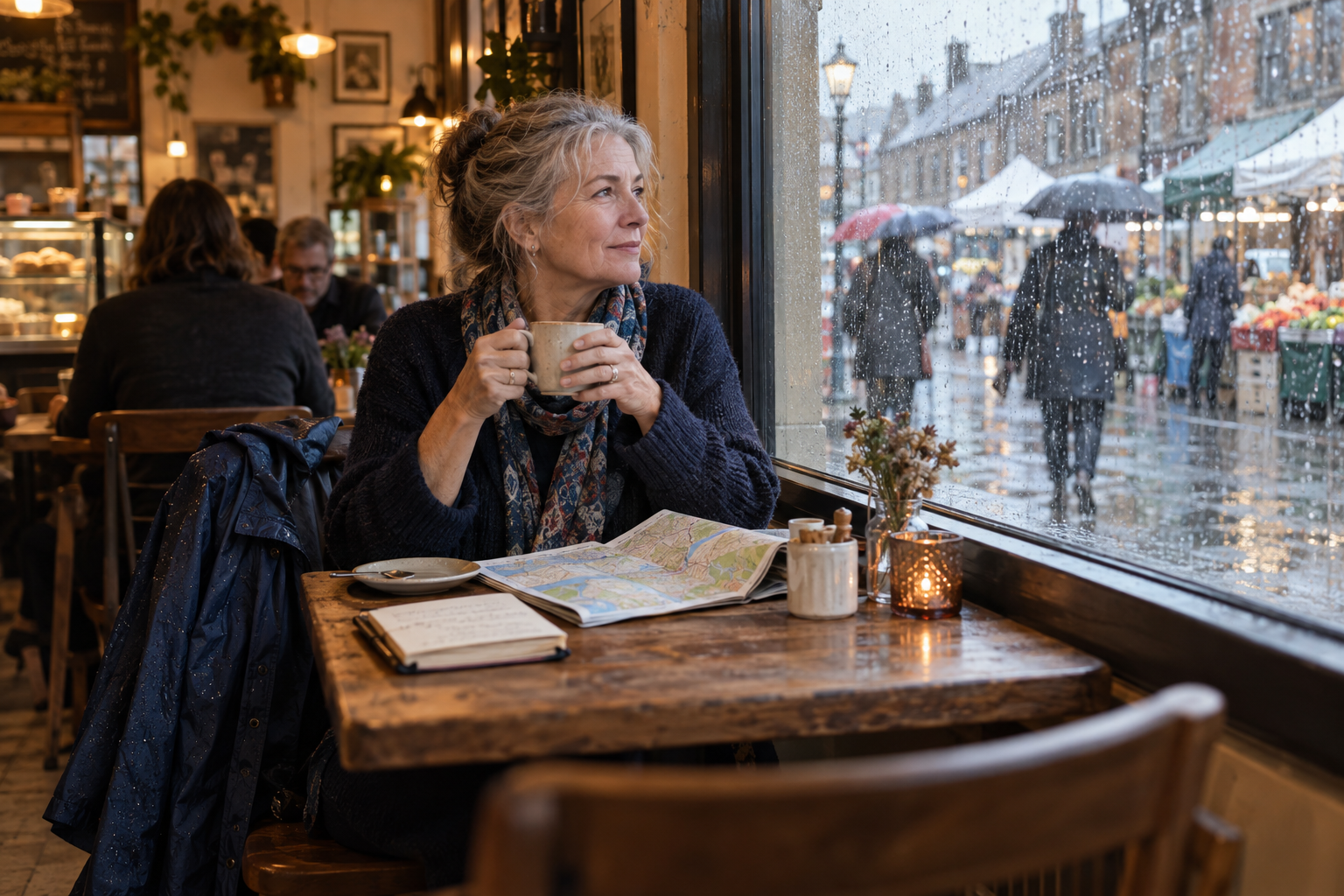
I have a bad habit on rainy mornings. I look out the window, see the trees bending sideways and behave as if the weather has cancelled not only my plan, but the entire concept of Saturday.
The walk is off. The lake looks miserable. A patio lunch is clearly ridiculous. Within twenty minutes I am making a second coffee, checking the same three things on my phone and drifting toward a day I never consciously chose.
And I am not talking about lovely, cinematic rain. I mean proper Ontario rain—the horizontal kind that finds the half-inch gap between your hood and your neck.
There is nothing wrong with occasionally giving in. Tea, a book and nowhere to be can be a first-rate arrangement. But I do object to losing six perfectly usable hours simply because the first idea did not survive contact with the forecast.
Bad weather is allowed to change the plan. I no longer think it should get custody of the whole day.
The original plan is gone. Fine. What would make the replacement day genuinely good?
Perfect days are a terrible planning system
We tend to plan for the day we ordered: sunny, comfortable, everybody available, traffic cooperative and the restaurant inexplicably holding the best table for us.
Reality has never agreed to those terms.
A useful retirement cannot depend on perfect conditions. That is too much power to hand the sky, other people’s calendars and the person who forgot to update the museum hours online.
I still like a plan. I simply trust it less than I used to. The better question is not, ‘Did the day go as planned?’ It is, ‘Was there something in it I was glad I did?’
That is a lower bar, admittedly. It is also a far more useful one.
The rainy Saturday that improved after we stopped sulking
A cycling day with a friend once collapsed before breakfast. The forecast had spent all week promising something tolerable, then Saturday arrived with steady rain and a wind strong enough to make the recycling bins adventurous.
We cancelled. I was irritated—not devastated, just annoyed enough to begin puttering around the house with no purpose whatsoever. I made coffee, looked at my phone and developed the vague belief that noon would eventually solve the problem for me.
Then my friend sent a message: ‘That new market is indoors. Want to go?’
The market led to lunch. Lunch led to a tiny local museum neither of us had ever bothered to visit. The museum was better than expected; the bakery on the way home was considerably better than expected.
We still wanted the bike ride, so we moved it to another day. But Saturday did not become a consolation prize. It became its own day—with excellent bread.
That is the standard I now use for Plan B: not ‘almost as good as the original,’ and certainly not ‘something worthy and improving.’ Just good enough that I am pleased I left the house.
Make a Plan B list before you become unimaginative
When plans fall apart, I become noticeably less creative. Ask me on a sunny Tuesday what I might enjoy doing and I can produce a respectable list. Ask me while rain is battering the window and suddenly I can think of television, snacks and nothing else invented since.
So I keep alternatives. Not a schedule. Not a colour-coded self-improvement program. Just an escape hatch from the sentence, ‘Well, I guess there is nothing to do.’
- Miserable weather: an indoor market, museum, library, café, matinee, cooking project or inviting someone over.
- Someone cancels: a solo lunch, bookstore, photography outing, scenic drive or the place you keep saying you will visit ‘one day.’
- Low energy: read somewhere pleasant, make a favourite meal, sort a small batch of photographs, watch a good documentary or call someone easy to talk with.
- Restless but indecisive: leave the house for coffee first. Make the next decision from there.
A Plan B you actually like is useful. A Plan B that feels like punishment is merely another cancelled plan wearing sensible shoes.
Figure out what you were really after
Suppose you planned to hike. The trail is now mud, the rain is sideways and pretending that waterproof boots solve everything would be dishonest.
What were you looking forward to? The hike itself, perhaps. But maybe it was movement, trees, conversation, novelty or simply getting out of the house before you became too familiar with the kitchen.
Once you name the part that mattered, the replacement becomes easier. Movement might become a swim or an indoor walk. Company might become coffee. Novelty might be a neighbourhood, gallery or market you have never explored. Nature might be a short walk during a break in the rain rather than three heroic hours in wet trousers.
The substitute does not need to impersonate the original plan. It just needs to carry some of the same reason you wanted the day in the first place.
Every retirement needs a few weatherproof pleasures
I am strongly in favour of outdoor interests. Walking, paddling, gardening and day trips make life better. They also make you vulnerable to a sky that has no interest in your plans.
A life built entirely around fair weather is fragile. You need another gear.
- Cooking something that takes a little longer than dinner usually gets
- Reading a book somewhere other than your usual chair
- Music, woodworking, painting, games or photography editing
- Learning something for no practical reason
- Visiting an indoor attraction you normally save for tourists
- Planning a future trip—without turning it into three hours of hotel-price comparison
Watching television also counts. I am not going to pretend every wet afternoon requires pottery, cultural enrichment and a lentil dish. But it helps to have more than one answer when the weather closes the door.
I do not believe in aggressive positivity
Some days are disappointing. If you had been looking forward to a paddle, concert, picnic or visit and it falls apart, you are allowed to be annoyed. I do not believe every setback is secretly a gift. Sometimes rain is just rain, and sometimes the alternative is plainly not as good.
Flexibility is not pretending you did not care. It is letting yourself complain for a reasonable amount of time without donating the rest of the day to the complaint.
Have the sulk. Make another coffee. Say something unkind about the forecast. Then decide whether the weather has already taken enough.
The two-hour rescue
When a day begins drifting, trying to rescue all of it feels oddly exhausting. I use a smaller target: save two hours.
Go somewhere. Make something. Call someone. Start one small project. Cook lunch properly. Read in a café. Browse a market. Take photographs of the rain if you are feeling artistic—or merely stubborn.
Two chosen hours can change the memory of the entire day. You do not need a spectacular recovery. You only need one part that did not happen by accident.
One small thing to do today
Take 15 minutes and create a note on your phone called ‘My Plan B List.’ Then add the following:
- Three things you would genuinely enjoy on a rainy or unpleasant-weather day
- Two things you are happy doing alone if somebody cancels
- Two low-effort options for a day when your energy is not especially impressive
Be honest. Do not put ‘visit an important art exhibition’ if you would rather have soup in a good café and browse a hardware store. This is your emergency supply of decent days, not an application for a personality upgrade.
Keep the list where you can find it. The next time plans collapse, pick one thing before inertia gets comfortable.
A changed plan is not a lost day
Retirement will not unfold according to the forecast. People cancel. Roads close. Restaurants change their hours. Trails become mud. Energy arrives in unpredictable quantities. Rain happens with astonishing confidence.
The goal is not to control all of that. It is to get better at changing direction without making every detour feel like failure.
Some of the days you remember most clearly will come from things that were never supposed to happen: the restaurant you found because the first one was full, the small town you explored because traffic was backed up, the museum you entered because it poured, or the conversation that happened because something else was cancelled.
I will still complain when a good outdoor plan gets washed out. I know myself too well to promise otherwise. But I am trying to stop confusing ‘not the day I expected’ with ‘no day at all.’
And if the detour contains a warm café and a very good bakery, I am prepared to call the whole thing a success.
What is one Plan B activity you enjoy enough that a cancelled plan would not feel quite so disappointing?