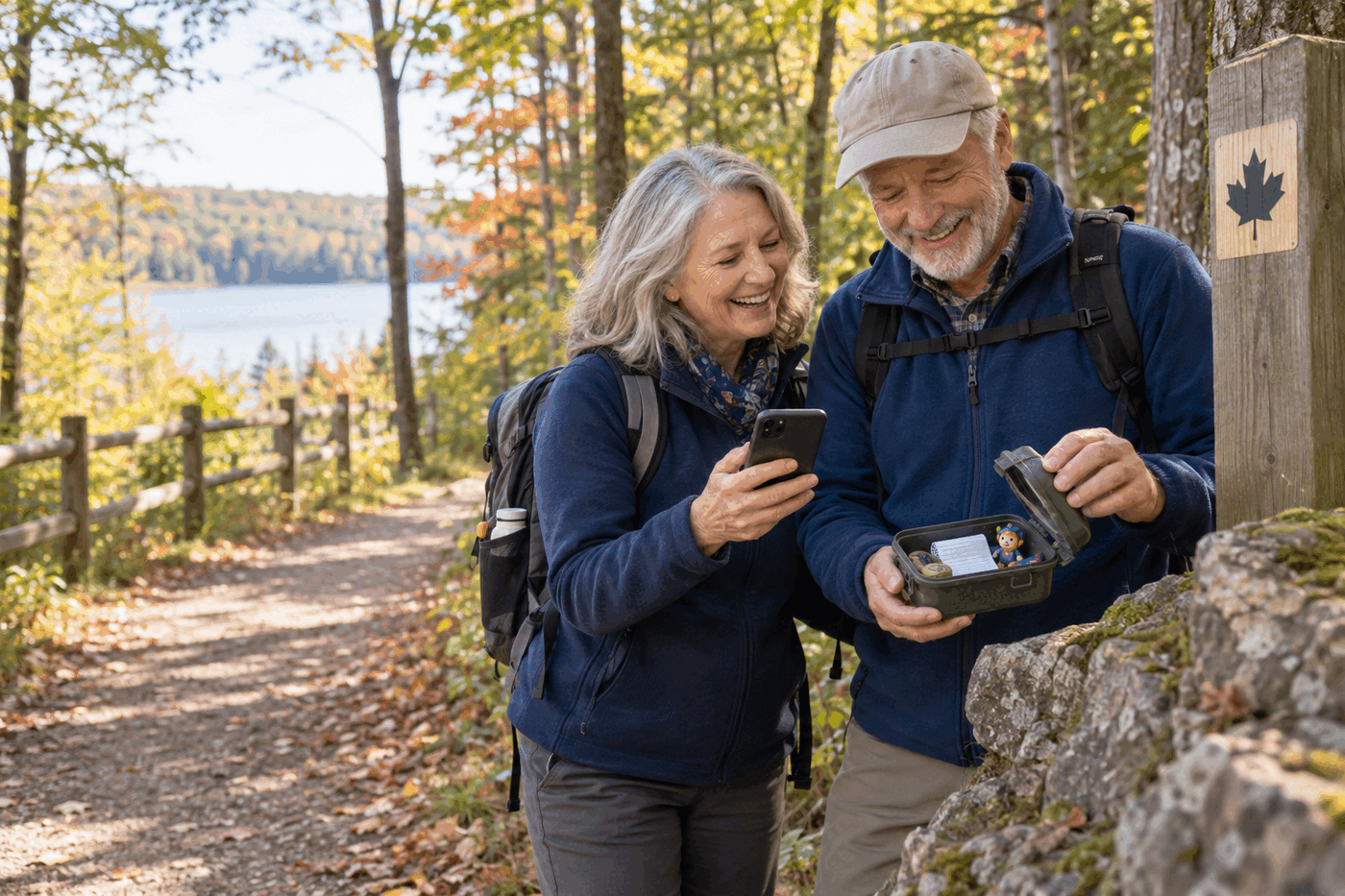
Somewhere near you, there is probably a tiny waterproof container hiding beneath a bench, behind a loose-looking piece of bark or inside an object that appears far too ordinary to be interesting.
You may have walked past it dozens of times. Someone else knows it is there. Your phone can lead you close—but the final few metres are up to you.
That is geocaching: a real-world treasure hunt using GPS coordinates to find containers and location-based challenges placed by a worldwide community. You navigate to the listed area, search carefully, sign the physical logbook when there is one, replace everything as found and record the adventure online.
The treasure is rarely the trinket. It is the trail, viewpoint, historic corner or surprisingly interesting Tuesday the coordinates helped you discover.
Why it fits life after 50 so well
Geocaching has an unusually adjustable difficulty dial. One day can be a short, accessible find beside a paved path. Another can involve a long forest walk, a multi-stage puzzle, a paddle-in island cache or an entire road trip built around a string of discoveries.
It blends movement with observation and problem-solving, without requiring you to move quickly or compete with anyone. It can add purpose to a neighbourhood walk, introduce you to parks you never noticed and make travel more personal than simply following the standard attractions.
It can also be social without demanding that it be social. Hunt alone, bring a partner or grandchildren, join a local event, or simply exchange stories through online logs.
- Gentle outdoor activity at your own pace
- A reason to explore unfamiliar parks, towns and trails
- Puzzles and navigation that keep the mind involved
- An easy hobby to share with a partner, family or local group
- A natural companion to hiking, cycling, kayaking, photography and travel
How the game works
Every listed geocache includes coordinates, a description, its approximate container size, attributes, recent finder logs and two important ratings: difficulty and terrain. Geocaching uses a five-star D/T scale.
Difficulty describes how challenging the cache is to solve or spot. Terrain describes the physical route and access. A terrain rating of 1 generally indicates wheelchair-accessible terrain; higher ratings can involve longer walks, steep ground, water travel or specialized equipment. Ratings are local and subjective, so read the description and recent logs rather than relying on the number alone.
Your phone normally gets you into the search area—not directly to the container. Tree cover, buildings and normal GPS variation can leave you searching a circle several metres wide. That last step is where geocaching becomes a game of observation.
Beginner stage: make the first find easy
Start in a familiar park, conservation area or walkable downtown. Avoid tiny ‘micro’ containers for the very first hunt; they can be wonderfully clever and wonderfully maddening.
If you do not find it, log a DNF—Did Not Find. That is useful information for the cache owner and a normal part of the hobby. Your eyes will get better remarkably quickly.
- Create a free account at Geocaching.com and install the official Geocaching app.
- Choose a traditional cache near home with a low D/T rating, a regular or larger container and several recent ‘Found it’ logs.
- Read the description, attributes and hint before leaving. Confirm that the cache has not recently been reported missing or damaged.
- Bring a charged phone, pen, water and comfortable footwear. Download or screenshot essential details if mobile service may be weak.
- Navigate to the area, put the phone away briefly and look for something that seems slightly out of place.
- Sign the log, close the container properly, replace it exactly and log the find online without revealing the hiding spot.
What should go in your first geocaching kit?
- A charged smartphone and compact power bank
- Two pens or pencils—because the cache pen will eventually disappoint you
- Water, sun protection and seasonal insect protection
- A small flashlight for looking under safe, visible spaces
- Work gloves for rough containers—without reaching blindly into holes
- Tweezers for tightly rolled micro-cache logs
- A few inexpensive trade items for caches where trading is allowed
- A small garbage bag for Cache In, Trash Out stewardship
Never place food, scented products, medication, alcohol, weapons or anything unsafe in a cache. If you trade an item, leave something of equal or greater value.
What does geocaching cost?
If you already own a smartphone and walking shoes, the first outing can cost nothing. A Basic membership gives access to beginner-friendly caches in the official app, while the website offers broader searching tools.
A practical beginner kit normally falls between $0 and $50 CAD: pens, a small power bank and a few trade items are enough. Premium membership unlocks more cache listings, all D/T ratings in the official app and stronger filters; pricing can vary by country and purchasing platform, so check the current Canadian amount before subscribing.
A dedicated handheld GPS is optional. Entry and mid-range units commonly add a few hundred dollars, but most casual geocachers do not need one. At the adventurous end, remote travel, park fees, specialized outdoor equipment and satellite communication can make the hobby more expensive—but those costs belong to the expedition, not to geocaching itself.
Intermediate stage: add puzzles, stages and better stories
After 20 or 30 finds, the map begins to look less like a list of dots and more like a menu. This is the time to try different cache types and use the hobby to shape an outing.
Learn to read recent logs for subtle clues, use attributes such as wheelchair accessible or recommended at night, and save offline details before heading beyond reliable service. Local events are excellent places to learn search techniques and meet people without committing to an entire club schedule.
- Multi-Caches: visit one or more stages to collect information leading to the final container
- Mystery or Puzzle Caches: solve a puzzle before determining the final coordinates
- EarthCaches: visit a geological feature and answer questions rather than finding a container
- Adventure Lab experiences: app-guided, multi-stop walks often built around history, art or local stories
- Trackables: tagged objects with missions that travel from cache to cache
Where should Canadian beginners look?
Start with municipal parks, waterfront trails, conservation areas, rail trails and historic downtowns. In Ontario, dense pockets of caches can turn a visit to the Kawarthas, Niagara, Ottawa, Kingston or a small town along Lake Ontario into an easy half-day adventure.
Provincial parks, conservation lands and private properties set their own rules. Finding a published cache does not remove normal admission requirements, trail closures or access restrictions. Never cross a fence, enter restricted property or damage vegetation because an arrow points in that direction.
Parks Canada permits geocaching under specific national guidelines and at participating sites. Caches are intended to be accessible from trails or public areas, and trade items are not permitted in Parks Canada caches. Rules can differ by location, so check the park’s current page before visiting or attempting to place anything.
Coordinates are an invitation to explore—not permission to ignore signs, closures, private property or common sense.
Adventure stage: let the hobby travel with you
Once the basics feel natural, geocaching can become the thread connecting bigger adventures. Build a day around a scenic trail series, search by kayak, follow historic caches through a new city or find an EarthCache at a remarkable geological site.
Higher terrain ratings may involve scrambling, paddling, climbing, deep snow or specialized gear. Treat the activity named in the listing as the real undertaking: a paddle-to cache requires paddling judgment, a winter cache requires winter skills and a remote cache requires a proper backcountry plan.
Travel caching can lead you away from the obvious viewpoint and toward a neighbourhood mural, quiet ruin or local story you would otherwise miss. It is also one of the few hobbies that fits into a twenty-minute roadside stop and a multi-continent bucket list equally well.
Ready to hide your own cache? Slow down first.
Hiding is not simply placing a container and walking away. You need land-manager permission, accurate coordinates, a compliant location, a durable weatherproof container and a realistic plan for ongoing maintenance.
Geocaching HQ encourages people to find at least 20 caches before hiding their first one. That experience teaches you what makes a listing enjoyable, what poor coordinates feel like and how quickly a cheap container can become a wet box of paper.
Choose a place worth bringing people to, follow the current hiding guidelines and be prepared to replace logs, respond to reports and remove the cache if it can no longer be maintained. A good hide contributes something: a view, story, clever idea or satisfying little moment.
Safety, etiquette and the art of not looking suspicious
- Tell someone where you are going when heading beyond busy public areas
- Check weather, daylight, trail conditions and mobile coverage
- Do not reach blindly into holes, machinery, electrical equipment or spaces where wildlife may shelter
- Search discreetly around non-players and return the container exactly as found
- Never move a cache to a spot you think is better
- Avoid posting photos or details that reveal the hiding place
- Practise Leave No Trace and pick up litter when practical
- Turn back when the terrain exceeds your skill, equipment or comfort
Your first-week challenge
Geocaching rewards curiosity more than speed and attention more than athleticism. It can remain a gentle reason to walk through the park, or grow into puzzles, events, paddling routes and faraway expeditions.
The first step is wonderfully small: open the app, follow an arrow and discover what has been hiding in plain sight.
- Open the map and find three traditional caches within a comfortable distance of home.
- Choose the one with the lowest suitable D/T rating, a larger container and recent successful finds.
- Invite someone—or make it a solo mini-adventure—and give yourself forty-five unhurried minutes.
- Whether you find it or not, log the attempt and choose the next cache while your curiosity is still awake.