Golden temples, good coffee and a quieter kind of month beside the Mekong
In the mountains of northern Laos, the Mekong and Nam Khan rivers meet beside a town of gilded temples, old wooden houses and French colonial buildings. There are waterfalls worth travelling across the world to see, wonderful regional food and small hotels where breakfast comes with a garden view.
You could see the main sights in three days. Give Luang Prabang three weeks, though, and you may find that the best part happens between them.
It’s just after six on a November morning. Shopkeepers are lifting shutters, a woman is arranging baskets of sticky rice, and the smell of bread drifts from a bakery.
Along the roadside, residents wait quietly as Buddhist monks approach with their alms bowls. Their saffron robes catch the early light. Offerings are made, the procession continues, and the neighbourhood carries on with its morning.
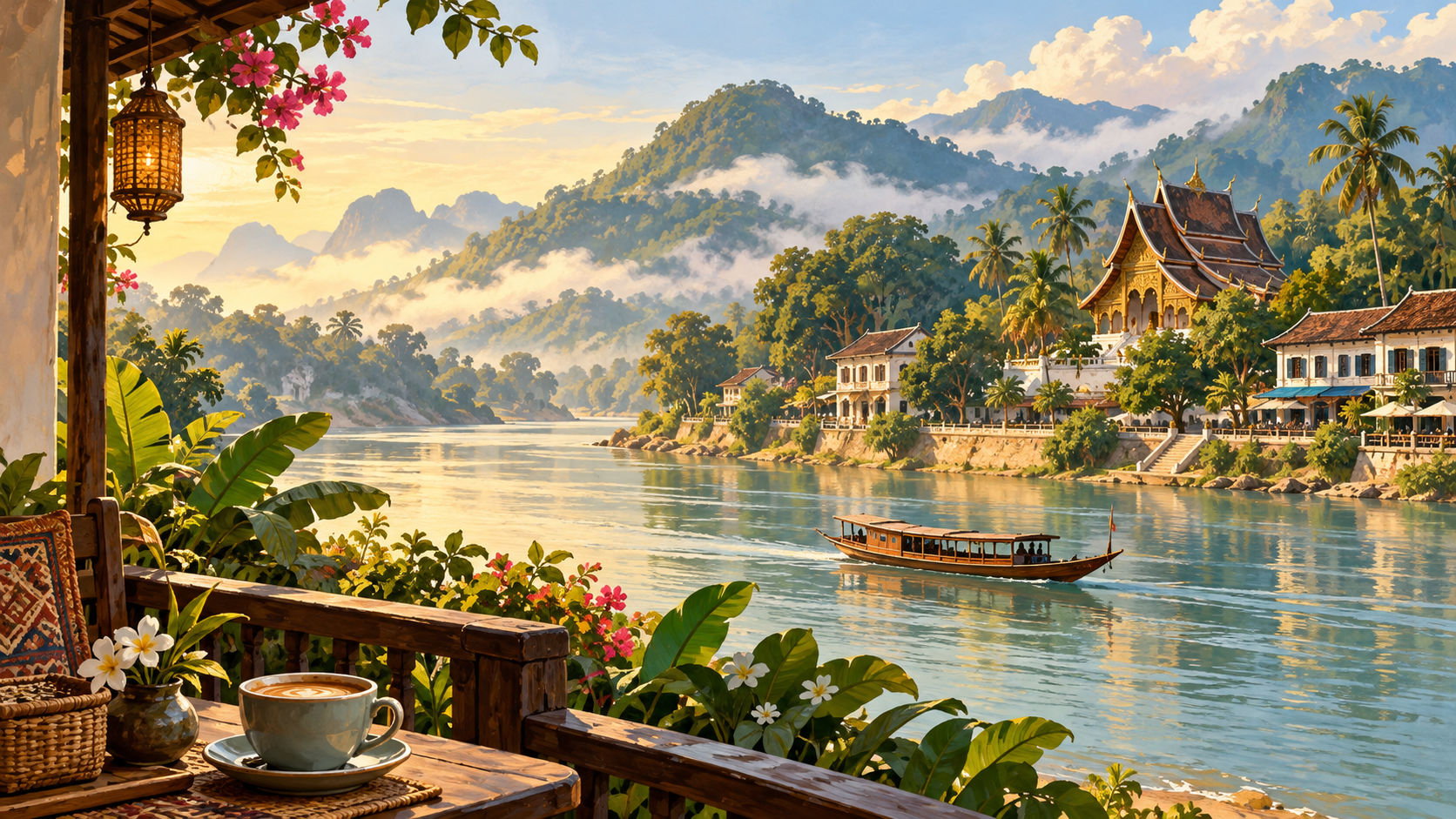
Later, you settle into a café overlooking the Mekong. Breakfast is a warm baguette, eggs, fruit and strong coffee. A narrow boat works its way upstream while mist hangs over the hills beyond the opposite bank.
You’ve been here nine days. During the first few, you visited temples, explored markets and went out to the waterfalls. Yesterday, you spent most of the afternoon reading beside the river. Today, you might return to the noodle shop you liked.
There’s time for another coffee before deciding.
That’s the appeal of Luang Prabang for travellers who enjoy staying somewhere long enough to develop a routine. The town offers plenty to explore, but it also makes an ordinary day feel pleasantly full.
📍 Why it deserves a place on your list
Luang Prabang’s historic centre occupies a narrow peninsula between two rivers, with mountains surrounding the town. Monasteries sit among traditional Lao houses, while colonial buildings now accommodate cafés, restaurants, galleries and guesthouses.
Its history reaches back centuries. A former royal capital and an enduring centre of Buddhist life, Luang Prabang later acquired the European architectural influences that remain visible today. UNESCO recognized this combination of Lao and colonial heritage when it designated the town a World Heritage Site in 1995.
The appeal goes well beyond attractive buildings. Monasteries remain active, markets supply household kitchens, and nearby workshops produce woven textiles and handmade paper. Spend a little time here and those everyday connections become as interesting as the famous sights.
The compact historic centre also suits a longer visit. You can walk between breakfast, a temple, a bookshop and the river without organizing transportation. For trips farther afield, arrange a driver or a suitable boat excursion.
There are expensive ways to enjoy Luang Prabang, certainly. But a satisfying day might cost little more than a few meals, a temple admission and a couple of coffees.
🌤️ When to go—and when to think twice
Weather matters here, particularly if you intend to spend several weeks walking and exploring. So does air quality.
November to February: the strongest starting point
These are generally the most comfortable months, with drier weather, warm afternoons and cooler mornings. December and January can feel surprisingly fresh early in the day, so bring a light layer.
November is especially appealing because the countryside often retains its rainy-season greenery. December brings comfortable conditions for exploring, while January offers a welcome escape from a Canadian winter.
For a first extended stay, I’d start by looking at late November through December. Popular dates can command higher accommodation prices, so compare a few different arrival weeks.
March and April: heat and the possibility of heavy smoke
Spring deserves more caution. Temperatures rise, and seasonal burning across the region can bring serious haze and poor air quality.
That changes the experience considerably. Mountain views disappear, afternoon walks become uncomfortable, and spending time outdoors may be difficult—especially for anyone sensitive to smoke.
Lao New Year takes place in April and can be a memorable occasion, but I wouldn’t choose this period for a first month-long stay built around comfortable outdoor living.
May to September: lush scenery and flexible plans
The rainy season brings green hills, fuller waterfalls and high humidity. Heavy showers can disrupt outings, and rural travel may be more difficult.
There’s real beauty in visiting at this time, particularly if you enjoy photography and don’t mind adjusting your day around the weather. For a first visit, however, the cooler dry season makes life easier.
October: worth considering
Late October can be a useful compromise. The landscape is green, waterfalls can be impressive, and peak-season crowds may not yet have arrived.
Rain remains possible. Book with some flexibility and leave room to rearrange outdoor excursions.
✈️ Getting there from Canada
Reaching Luang Prabang from Canada usually means travelling through an Asian hub, then taking a regional flight.
Bangkok is a practical option, particularly if you’d enjoy spending a few days there before continuing. Vietnam or another regional gateway may also fit, depending on flight schedules and fares.
A planning allowance of C$2,200–3,200 per person return is a starting budget for the complete journey, rather than a live fare quote. Compare the full cost of baggage, connections and transfers before booking.
If you buy separate tickets, give yourself a generous connection buffer. An overnight stop can make the journey more comfortable and reduce the consequences of a delayed inbound flight.
Could you include the railway?
The Laos–China Railway makes it possible to combine Luang Prabang with places such as Vientiane without spending a long day on mountain roads.
The train journey between Vientiane and Luang Prabang takes roughly two hours, depending on the service. Check current ticket prices, booking arrangements and station transfers before building it into your itinerary.
For slow travel, the railway is useful. There’s still no obligation to keep moving once you’ve found somewhere you like.
💰 What everyday life might cost
Laos uses the Lao kip, or LAK. Exchange rates and local prices can move considerably, so Canadian-dollar figures should be treated as planning estimates.
There’s also a meaningful difference between local prices and visitor prices. A neighbourhood noodle shop, a polished café and a riverside hotel restaurant serve different markets. You can enjoy all three, but your choices will shape the budget.
The same applies to accommodation. A local rental on a long lease is a different proposition from a furnished apartment available for exactly four weeks.
The following ranges provide a broad starting point:
Transport prices depend on distance and arrangements, while accommodation varies with season, location and comfort. Confirm actual quotes before treating any estimate as settled.
| Expense | Approximate cost in Canadian dollars |
|---|---|
| Simple local breakfast | $3–6 |
| Café breakfast | $7–12 |
| Local noodle soup | $2–5 |
| Casual restaurant lunch | $6–12 |
| Comfortable restaurant dinner | $12–25 per person |
| Upscale dinner | $35–65+ per person |
| Coffee | $2–4 |
| Comfortable guesthouse | $45–100 per night |
| Upscale boutique hotel | $120–250+ per night |
| Short local tuk-tuk ride | $3–8 |
| Traditional massage | $12–25 |
🍜 Come hungry: the food is a reason to stay
One of the pleasures of a month in Luang Prabang is having time to become familiar with Lao cooking.
At first, you might order dishes simply because they sound interesting. By the third week, you’ll know which noodle shop you prefer, how much chilli suits you and what you’d like alongside your sticky rice.
Northern Lao food makes generous use of herbs, vegetables, grilled ingredients and savoury condiments. French-influenced bakeries and restaurants add variety, which is welcome during a longer stay.
Sticky rice
Sticky rice accompanies many Lao meals, usually arriving in a small woven basket. Traditionally, diners take a little with their fingers and use it to accompany meat, vegetables and dips.
It quickly becomes part of the pleasure of eating here: simple, satisfying and well suited to sharing several dishes.
Or lam
This Luang Prabang specialty is an aromatic stew made with meat, vegetables and herbs. Recipes vary, and some include sakhan, a peppery woody vine that gives the dish a distinctive character.
Try it somewhere known for traditional Lao cooking, and ask the staff about their version.
Lao khao soi
If you know the coconut-rich khao soi of northern Thailand, expect something different.
Luang Prabang’s version commonly features rice noodles in broth with a savoury minced-meat and tomato topping. Herbs and other accompaniments let you adjust each bowl to your taste.
It makes a particularly good breakfast or lunch.
Jaew bong
This local chilli paste brings heat, sweetness and a deep savoury flavour to the table. Traditional versions may contain buffalo skin, so ask about ingredients if you have dietary restrictions.
Start with a small amount alongside sticky rice.
Luang Prabang sausage
Herb-filled pork sausages appear in markets and restaurants, often grilled and served with vegetables, sticky rice and a dipping sauce. They’re an easy introduction to the flavours of northern Laos.
Khaiphaen
Made from freshwater river algae, khaiphaen is dried into thin sheets, often with seasonings and sesame seeds, then fried until crisp.
Order some with jaew bong. It’s a memorable combination and something you’re unlikely to encounter at home.
Bakeries and familiar comforts
Baguettes, pastries and café breakfasts are easy to appreciate after an early walk. Some days you’ll want noodles and herbs; other days, a croissant and coffee will be exactly right.
A longer stay gives you room for both.
🧭 Seven experiences worth making time for
1. Observe the morning alms ceremony thoughtfully
The morning alms procession is a religious practice with deep significance for the community.
Learn about it before attending. Dress modestly, keep a respectful distance, avoid flash and leave the monks’ route clear. If you wish to participate, seek proper local guidance first.
Quiet observation is entirely appropriate. You don’t need to make an offering—or take a photograph—to appreciate the occasion.
2. Make the morning market part of your routine
Go early, when vendors are selling herbs, vegetables, fruit, fish and ingredients you may never have cooked with.
Buy breakfast nearby, pick up some fruit and take your time. Ask before photographing people.
If your accommodation has a kitchen, market visits become especially rewarding. Even preparing a simple breakfast with local ingredients creates a different connection to a place.
Phosi Market is also worth exploring for a broader view of everyday shopping beyond the historic centre.
3. Visit Wat Xieng Thong, then explore a few quieter temples
Wat Xieng Thong deserves its reputation. Its sweeping rooflines, elaborate decoration and Tree of Life mosaic reward a careful visit.
Afterward, choose a few other monasteries rather than trying to visit every temple in town. Notice the differences, read about their history and allow time to sit quietly.
These are active religious spaces. Follow posted guidance, dress appropriately and respect areas reserved for worship.
4. Give Kuang Si Falls most of a day
Kuang Si lies roughly 30 kilometres outside town, where cascades spill through forest into pools that can appear brilliantly turquoise.
Arrive early if you can. Walk at an easy pace, visit the bear rescue centre and leave time to enjoy the setting.
Water colour and conditions change with weather and rainfall. Swim only where permitted and follow current local instructions.
Confirm entrance fees and transport costs before setting out; older online prices may no longer apply.
5. Take a carefully chosen Mekong boat trip
The journey toward Pak Ou Caves offers river views, passing villages and time to appreciate the landscape beyond town. The caves themselves contain thousands of Buddha images.
Choose an operator with appropriate safety equipment and a properly fitting life jacket. Ask about the vessel and conditions, rather than booking solely on price.
A comfortable slow boat lets the journey become part of the day’s pleasure.
6. Spend a morning with local craftspeople
The weaving and papermaking communities around Ban Xang Khong and Ban Xieng Lek offer a chance to understand the work behind the textiles and paper sold in town.
Watch a loom in use. Ask how materials are prepared. Learn a little about the patterns.
If you find something you love, buying directly from its maker gives the purchase a story you’ll remember.
7. Visit the UXO Lao Visitor Centre
Laos continues to live with the consequences of unexploded ordnance left by wartime bombing.
The UXO Lao Visitor Centre explains that history, its continuing human cost and the work of clearance teams. It’s a sobering visit that adds essential context to time spent in the country.
In rural areas, stay on established routes and marked paths. Follow local guidance about where it is safe to walk.
❤️ What a good ordinary day looks like
By your third week, you’ve stopped checking a sightseeing list each morning.
You walk to the bakery, where the woman behind the counter recognizes your order. After breakfast, you buy fruit and a few groceries. There’s a small temple you’ve passed several times, so today you step inside.
Lunch is noodle soup at a place recommended by your café owner. You’re back at the accommodation during the hottest part of the afternoon, with a book and the air conditioning on.
Later, you walk toward the Mekong. Boats are returning, the light softens, and you find a table for dinner.
You might visit the night market afterward. You might head back early.
Tomorrow could be a cooking class or a countryside outing. There’s no need to decide before bed.
This is where Luang Prabang earns its place as a slow-travel destination. The days remain interesting after the major sights are familiar.
🏡 Could it work as a retirement destination?
For a winter stay, Luang Prabang has considerable appeal: warm weather, enjoyable walking, regional food, attractive accommodation and enough cultural depth to sustain several weeks.
Permanent relocation calls for a separate assessment.
The financial picture
Everyday expenses can be modest, but a retirement budget must include more than food and rent.
Visitor accommodation, insurance, international flights, imported goods and medical travel can change the total substantially. A month’s enjoyable spending also doesn’t tell you what a year of living there would cost.
An extended visit is a useful way to explore the idea without making a major commitment.
Visas and length of stay
A month on the calendar doesn’t always fit neatly within a 30-day permission to stay.
Check the current entry rules for your passport, your intended arrival point and the exact number of days you’ll be in the country. Use the official Lao eVisa and immigration sources, and confirm extension procedures before relying on them.
A tourist visit also doesn’t establish eligibility to live in Laos long term. Anyone considering relocation should investigate the appropriate immigration route separately.
Healthcare deserves serious attention
For a longer stay, healthcare access may be the deciding factor.
Routine treatment and complex specialist care are different needs. Before booking, establish what care is available locally, what your insurance covers and how an evacuation would be handled if necessary.
Anyone who needs regular specialist appointments or a dependable supply of specific medication should investigate those arrangements carefully.
Luang Prabang may suit a healthy traveller for several weeks while being a less practical base for someone with ongoing complex medical needs.
⚖️ The pleasures—and the compromises
The key is choosing accommodation and travel dates that support the way you actually want to spend your days.
| What makes a longer stay appealing | What deserves a closer look |
|---|---|
| A compact, characterful historic centre | Uneven pavements, heat and traffic can affect walking |
| Temples, crafts and living cultural traditions | Popular areas can become busy with visitors |
| Excellent regional food and appealing cafés | Imported food and premium dining increase costs |
| Rivers, waterfalls and nearby countryside | Transport quality and safety vary |
| Attractive small hotels and guesthouses | Soundproofing, plumbing and Wi-Fi can be inconsistent |
| Generally pleasant winter conditions | Seasonal smoke can seriously affect outdoor plans |
| Modest costs for many everyday pleasures | Healthcare, insurance and international travel need separate budgeting |
🏡 Could I actually stay here for a month?
Yes—Luang Prabang deserves a serious look if you enjoy culture, food, riverside walks and an unhurried routine.
For a first stay, compare properties on the historic peninsula with options just beyond it, including areas around Ban Visoun and Ban Vieng Mai.
Location matters at the individual-property level. A quiet room within easy walking distance of restaurants may be worth more to you than a prettier address on a noisy street.
What to look for in accommodation
For four weeks, practical comfort matters every day:
A kitchen is useful if you enjoy cooking. If you expect to eat out most days, a fridge and a simple breakfast setup may be sufficient.
Ask whether a monthly discount is available, and get the complete price and inclusions in writing.
- A comfortable bed and effective air conditioning.
- Dependable hot water and a refrigerator.
- A pleasant place to sit during the afternoon.
- Recent reviews that mention noise and cleanliness.
- Reliable Wi-Fi, ideally supported by a recent speed test.
- Clear arrangements for laundry, cleaning and utility charges.
Shopping and eating
Markets make fruit, vegetables, eggs, rice and herbs easy to incorporate into your routine. Imported cheese, wine and familiar packaged foods can be comparatively expensive.
You can keep meal costs comfortable by mixing local restaurants, café visits and occasional more elaborate dinners. Frequent Western-style breakfasts and hotel dining will produce a different budget.
Getting around
You don’t need a car for a stay centred on the old town. Walking covers many daily needs, with tuk-tuks or arranged transport for longer journeys.
For countryside outings, a reputable driver is a practical choice. Consider the route and traffic before deciding whether cycling suits a particular excursion.
Internet and daily services
Check the connection at the actual property rather than relying on a general promise of “free Wi-Fi.” A local mobile-data option can provide useful backup.
Cash remains important for everyday purchases. Ask your host about nearby ATMs, laundry services, drinking water and grocery shopping during your first few days.
Two likely irritations
Accommodation that looks better than it functions. Beautiful photographs reveal little about mattresses, barking dogs, water pressure or walls that transmit every conversation.
Afternoon heat and mosquitoes. Plan longer walks earlier in the day, keep a comfortable place to retreat to, and use appropriate mosquito precautions.
Neither needs to spoil a stay. Both are easier to manage when you plan for them.
💰 A working monthly budget for two
These are planning ranges, rather than confirmed accommodation or service quotes.
Using an illustrative exchange rate of approximately 15,757 kip to C$1, that works out to roughly C$1,570–2,890 for two people.
A working target of C$2,200–2,500 could be reasonable if you secure accommodation within the assumed range and combine local meals with occasional more expensive outings.
Flights, visas and travel medical insurance are additional. Recalculate the Canadian-dollar total using the exchange rate available when you book.
Start with accommodation quotes, then build the rest of the budget around them. That will tell you far more than a general cost-of-living comparison.
| Expense | Monthly allowance |
|---|---|
| Furnished accommodation | 12–22 million kip |
| Groceries | 3–5 million kip |
| Restaurants and cafés | 4–7 million kip |
| Local transportation | 1.5–3 million kip |
| Activities and excursions | 2–4 million kip |
| Utilities, phone and internet | 0.7–1.5 million kip |
| Miscellaneous spending and contingency | 1.5–3 million kip |
| Total | 24.7–45.5 million kip |
🧳 Is Luang Prabang worth a month?
For travellers who enjoy history, regional food, traditional crafts and beautiful surroundings, there’s a strong case for it.
You can explore a temple in the morning, have lunch at a neighbourhood noodle shop and spend the afternoon beside the river. On another day, head out to a waterfall or a weaving village. There’s enough variety to keep you curious without requiring a packed schedule.
The limitations deserve equal weight. Specialist healthcare is a major consideration, seasonal smoke can affect the experience, and accommodation needs careful selection.
For a first extended visit, I’d look at three or four weeks in November or December, with a comfortable base within walking distance of the historic centre.
Use the first week to get your bearings. Arrange a few countryside outings and cultural activities once you know the town.
Leave the final week fairly open.
By then, you may have a favourite breakfast place, a familiar walking route and a restaurant where someone remembers you. Returning to those places can be as satisfying as discovering somewhere new.
🌏 Three other places to consider
Chiang Rai, Thailand: A good possibility if northern culture, temples, markets and countryside excursions appeal to you.
Siem Reap, Cambodia: Particularly rewarding if you’d like time to explore Angkor gradually, alongside markets, restaurants and village outings.
Ninh Binh, Vietnam: Worth investigating for limestone scenery, rice fields, cycling and boat journeys through the surrounding countryside.
Each offers a different daily rhythm. Compare accommodation, transport and healthcare arrangements as carefully as the attractions.
🌿 Luang Prabang at a glance
| Detail | Planning guide |
|---|---|
| Best overall season | Generally November–February |
| Preferred period | Late November–December |
| Ideal first extended visit | Three to four weeks |
| Working monthly target for two | C$2,200–2,500, subject to accommodation quotes |
| International airfare allowance | C$2,200–3,200 per person return |
| Car required | No, for a stay based around the historic centre |
| Accommodation to investigate | Comfortable furnished studio, apartment or guesthouse |
| Main appeal | Culture, food, temples, rivers and nearby nature |
| Main practical concerns | Healthcare access, seasonal smoke and accommodation quality |
| Longer-term potential | Worth testing through an extended visit; immigration needs separate research |
The question to take home
Would you enjoy the ordinary days here?
The bakery visit. Buying fruit. Returning to a restaurant because you liked the food and the welcome. Sitting out a hot afternoon, then walking to the river when the light softens.
A month gives you time to find out.
You may discover somewhere you’d happily return to every winter. You may enjoy the visit while deciding that you prefer a destination with different healthcare arrangements or more familiar conveniences.
Either outcome is useful.
That’s part of the value of slow travel: enough time to discover how a place fits your life, beyond the view from a hotel balcony.
In Luang Prabang, there’s a good chance you’ll want to give that question another week.