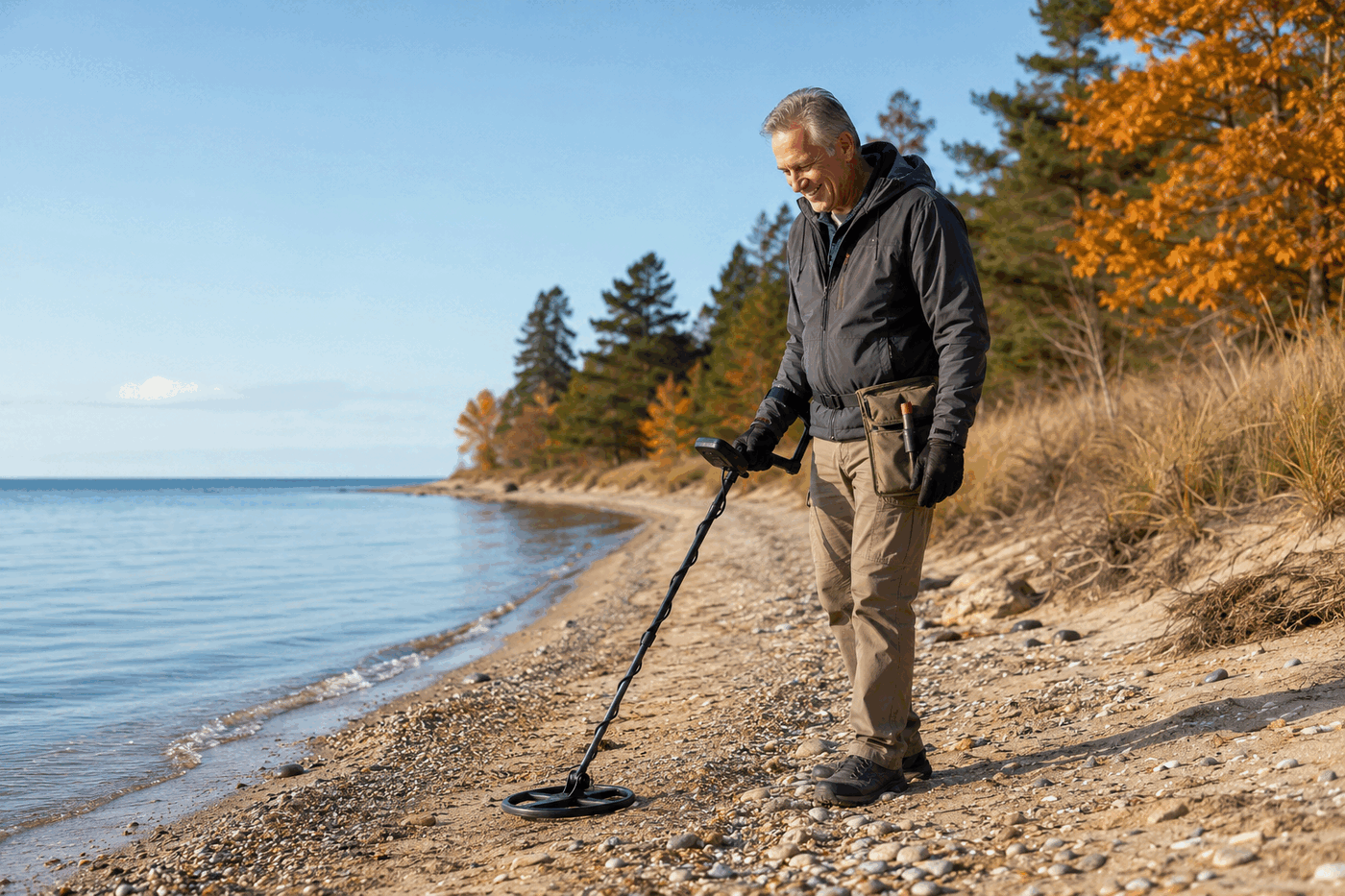
The signal is small—just a clean tone in your headphones—but it changes an ordinary walk. You sweep the spot again, slower this time. The number holds steady. A few careful minutes later, a dark little object appears in the soil.
It may be a modern coin, an old button or another bottle cap. You do not know yet, and that is precisely the pleasure.
Metal detecting combines gentle movement, outdoor time, research and the quiet thrill of discovery. You can spend an hour in a familiar yard, meet friends for a morning hunt or build an entire trip around a coastline and its stories. The machine may find the metal; your curiosity finds the meaning.
Why it fits retirement so well
Detecting gives a walk a purpose without turning it into a race. Sessions can be short, the pace is yours and modern equipment can be comfortably light. The mental work—interpreting tones, reading the ground and researching old maps—can be as absorbing as the search itself.
It also leaves room for solitude and community. Some detectorists value quiet concentration; others join clubs, swap stories and help return lost rings. The hobby can grow with your energy and ambition, from local parks to beach trips and carefully arranged searches on private farmland.
- Gentle, adjustable activity with frequent pauses.
- A reason to explore local history and overlooked places.
- Skill development that rewards patience more than speed.
- Social outings without pressure to compete.
- A portable hobby that can add purpose to travel.
Before the first beep: permission comes first
Owning a detector does not create a right to search or dig. Rules differ by property owner, municipality, conservation authority, province and country—and the rules for operating a detector may differ from those for disturbing soil or removing an object.
In Ontario, begin with your own property or private land where the owner has given clear permission. For a municipal park, beach, schoolyard, conservation area or Crown land, contact the responsible authority and ask specifically whether detecting, target recovery and removal are permitted at that exact location.
- Treat national parks and national historic sites as off-limits unless Parks Canada has given specific written authorization. Digging, disturbing the ground and removing natural or cultural objects are illegal in national parks, and many locations expressly prohibit detectors.
- Never detect on a marked or suspected archaeological site, cemetery, battlefield, Indigenous cultural site or ecologically sensitive area.
- If an object or concentration of finds may indicate an archaeological site, stop disturbing the area, record the location without publicizing it and contact Ontario’s archaeology program for guidance.
- Get permission in writing when possible, agree in advance on how finds will be handled and leave every site better than you found it.
Your first setup: useful, not extravagant
Avoid toy machines that cannot separate common trash from worthwhile targets. A reputable entry-level detector with clear target identification, several search modes and an adjustable shaft is enough for a full first season.
Broad Canadian prices below were checked in September 2026 and vary by retailer, sales and exchange rates.
- Entry-level detector: approximately C$250–C$550.
- Pinpointer: roughly C$120–C$220. This small handheld probe saves time and reduces unnecessary digging.
- Digging tool or sand scoop: about C$30–C$100, chosen for the permitted terrain.
- Headphones, finds pouch, gloves and knee protection: around C$75–C$200 in total.
- Comfortable complete beginner setup: generally C$475–C$950.
Do not buy for imagined adventures. If saltwater beaches are genuinely part of your plan, look for a machine designed to handle wet salt sand. If you will search mostly parks and yards, prioritize simplicity, comfort and good target separation. A lighter machine you enjoy carrying will outperform an impressive one left at home.
What the controls actually do
- Sensitivity controls how strongly the detector responds. Maximum sensitivity is not always better; unstable chatter can hide good signals.
- Discrimination lets the machine reject or de-emphasize some targets, often iron. Heavy filtering can also hide interesting objects.
- Target ID gives a numerical estimate of conductivity. It is a clue, not a guarantee—rings, foil and pull tabs can overlap.
- Ground balance helps the detector account for minerals in the soil. Some beginner machines handle this automatically.
- Search modes apply useful starting settings for parks, fields or beaches. Learn one mode well before changing everything.
Your first four outings
- Build a small test garden in your yard using modern coins, a pull tab, foil and an iron nail placed on the surface or in labelled shallow spots. Learn the sounds without guessing.
- Search your own yard for 30–45 minutes. Keep the coil level, close to the ground and moving in slow, overlapping arcs.
- With permission confirmed, try an open area with easy target recovery. Dig repeatable signals and compare the object with the tone and target number.
- Join a club outing or hunt with an experienced detectorist. Ask them to demonstrate clean recovery, not merely show their finds.
The clean recovery
Good technique protects the place and keeps detecting welcome. Before digging, pinpoint from two directions. Use the smallest recovery method the ground allows and avoid damaging roots, irrigation or buried services.
- On healthy turf where digging is allowed, cut a neat hinged plug rather than removing a loose circle of sod.
- Place loose soil on a cloth or recovery mat so none is scattered.
- Use the pinpointer to shorten the search inside the opening.
- Remove sharp trash even when it is not the treasure you hoped for.
- Replace the object-free soil, close the plug and press it level. The repair should be difficult to see.
- Stop when ground is excessively dry, frozen or too fragile to restore properly.
Where beginners can learn safely
The best location is not the oldest place—it is the legal place where you can practise without harming anything. Start close to home and verify permission every time.
- Your yard or a friend’s property, with agreement about who keeps any finds.
- A private beach or cottage property where the owner permits detecting and recovery.
- A farm field after harvest, but only with explicit landowner permission and away from known heritage features.
- A municipal park or public beach only after the responsible department confirms that both detecting and digging are allowed.
- An organized club hunt on land secured for that event.
High-traffic areas can hold modern coins, keys and jewellery near gathering places—but do not detect close to people, playground users or events. Old maps and aerial photographs can suggest former gathering areas, yet historical potential is also a reason to become more cautious about archaeology, not less.
A better way to read a signal
Beginners often chase the number on the display. Experienced detectorists collect several clues before deciding.
- Repeatability: Does the signal return in the same place on every pass?
- Direction: Does it sound clean when you sweep from ninety degrees as well?
- Size: Does the response feel coin-sized or spread over a large area?
- Depth: Is it a shallow recent loss or a weaker, deeper target?
- Context: Are similar objects appearing together, suggesting a spill—or something historically important that calls for stopping?
From beginner to specialist
There is no requirement to progress. A person who enjoys two local mornings a month is doing the hobby just as successfully as someone planning an expedition.
- Beginner — Learn one machine, dig plenty of ordinary trash, practise clean recovery and record what each target taught you.
- Intermediate — Research permissions and site history, log finds, learn ground balance and consider multi-frequency equipment for difficult soil or beaches.
- Advanced — Specialize in beach jewellery, relic research, shallow-water work or gold prospecting, using equipment and permissions designed for that environment.
- Mentor — Lead ethical outings, help newcomers avoid damaging sites and build respectful relationships with landowners and heritage professionals.
Make it comfortable enough to continue
- Adjust the shaft so you can sweep without hunching or reaching.
- Keep the coil just above the surface instead of pressing it into the ground.
- Use a supportive kneeling pad, long-handled recovery tool where permitted or a small folding seat for breaks.
- Carry water, sun protection, insect repellent, medication and a charged phone.
- Alternate your swing arm and keep sessions short while shoulders, back and hips adapt.
- Avoid isolated areas alone, tell someone your location and watch weather, tides and hunting-season activity.
Finds, ownership and the right thing to do
A valuable find is not automatically yours to keep. Ownership can depend on the landowner’s agreement, local law and the nature of the item. Make the arrangement before searching private property.
Try to return identifiable jewellery, keys and personal objects. Do not clean an old coin or artifact aggressively; improper cleaning can destroy both value and historical evidence. Photograph it as found, record the general context privately and seek expert advice when significance is uncertain.
Never sell a story to social media at the expense of a vulnerable site. Precise locations can invite trespass and looting. Responsible detectorists protect the ground that gave them the experience.
The B Side verdict
Metal detecting offers a rare combination: solitude and companionship, exercise and concentration, everyday accessibility and open-ended adventure. Most outings will produce ordinary coins and a heroic quantity of pull tabs. That is not failure. Every piece of trash teaches the machine—and makes the ground a little cleaner.
Start with permission, modest gear and a place you know. Swing slowly. Restore the earth carefully. Let the next clear tone be enough to make the walk interesting.
The best treasure may be the habit itself: a reason to keep moving, keep learning and keep wondering what story is waiting beneath your feet.