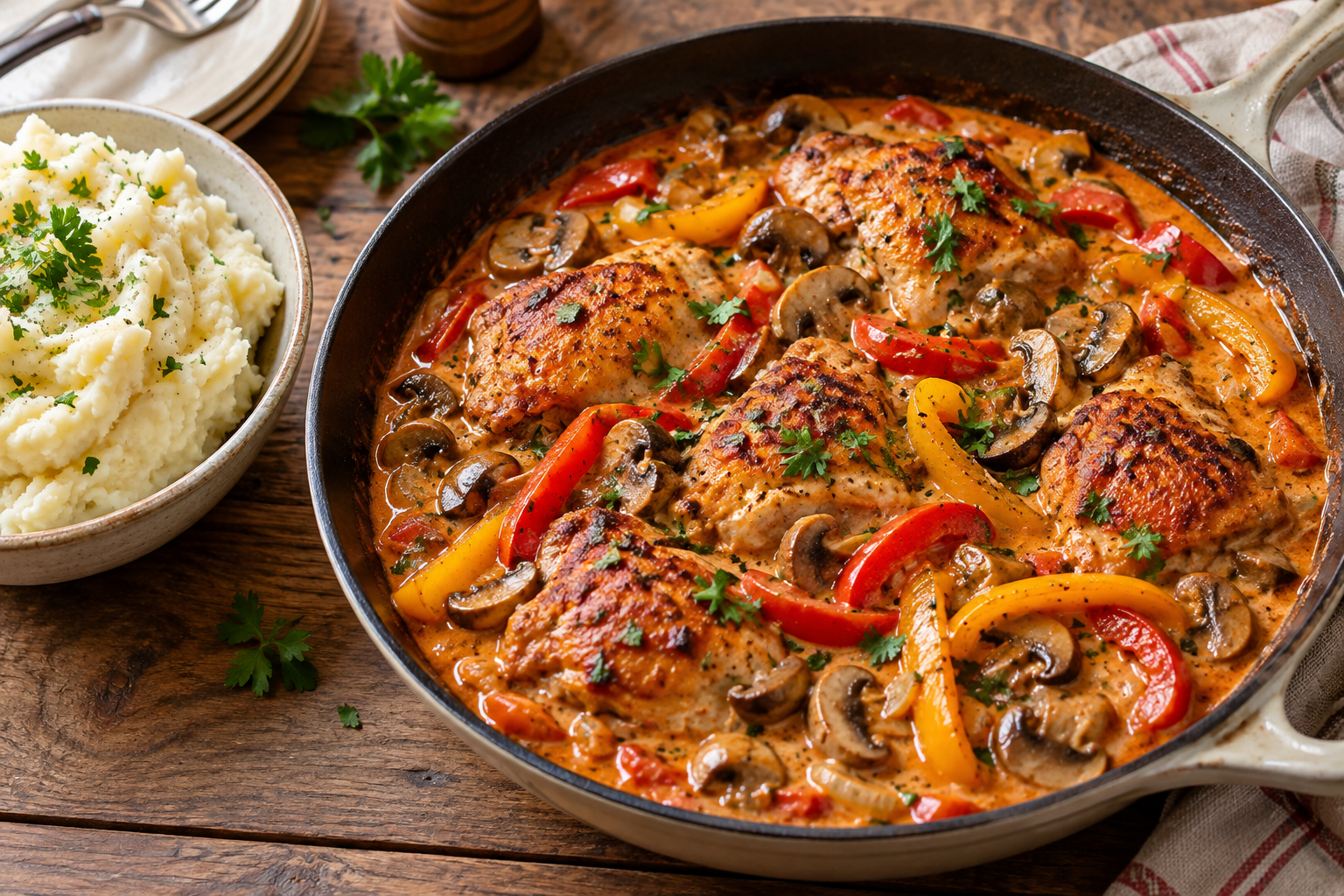
A cooler-evening kind of dinner
There are dinners that look impressive because somebody spent three hours making them. This isn’t one of those dinners.
As the evenings turn cooler, you want sauce: something savoury to spoon over potatoes, noodles or rice. You want the kitchen to smell good, you want leftovers, and you’d rather not dirty every pan you own achieving any of this.
This paprika chicken was built for exactly that mood. It’s loosely inspired by the comforting paprika-and-sour-cream flavours found throughout Central and Eastern European cooking, but it isn’t intended as traditional chicken paprikash.
We’re adding mushrooms, sweet peppers and Dijon, using boneless chicken thighs for convenience and working with ingredients available in an ordinary Canadian supermarket. The result lands somewhere between a braise and a skillet dinner: warm, savoury and slightly tangy, with enough sauce that mashed potatoes become almost mandatory. Almost.
Ingredients • For the chicken
- 2 lb / 900 g boneless, skinless chicken thighs
- 1 tsp kosher salt
- ½ tsp freshly ground black pepper
- 2 tbsp all-purpose flour
- 1 tbsp olive oil
- 1 tbsp butter
Ingredients • For the sauce
- 1 large yellow onion, sliced
- 8 oz / 225 g cremini or white mushrooms, sliced
- 1 red bell pepper, sliced
- 1 yellow or orange bell pepper, sliced
- 3 garlic cloves, minced
- 2 tbsp sweet paprika
- ½ tsp smoked paprika
- 1 tbsp tomato paste
- 2 cups / 475 mL low-sodium chicken broth
- 1 tbsp Worcestershire sauce
- 1 tsp Dijon mustard
- ½ tsp dried thyme
Ingredients • To finish
- ½ cup / 125 mL full-fat sour cream
- 1 tbsp Dijon mustard
- 1 tsp apple cider vinegar or fresh lemon juice
- 2 tbsp chopped fresh parsley
- Salt and black pepper, to taste
Dijon goes in twice: 1 teaspoon in the simmering sauce, then 1 tablespoon with the sour cream.
1. Season and brown the chicken
Pat the chicken thighs dry. Season with salt and pepper, then sprinkle with the flour and toss lightly until just coated. We’re not breading them: that small amount of flour helps browning and gives the sauce a little body.
Heat the olive oil and butter in a large Dutch oven or deep skillet over medium-high heat. Add the chicken in a single layer, working in two batches if needed.
Brown for approximately 3 minutes per side. The chicken does not need to be cooked through yet. Transfer it to a clean plate.
Give the chicken room. Crowding traps steam and makes browning harder.
2. Brown the mushrooms, then soften the peppers
Add the mushrooms to the same pan. Leave them alone for a minute or two before stirring so they have time to brown. Cook for about 4 minutes in total.
Add the onion and peppers. Cook for another 5 minutes, stirring occasionally, until the onion softens and the peppers begin losing their raw edge.
Add the garlic and cook for about 30 seconds. Now the kitchen should be getting interesting.
3. Wake up the paprika and build the sauce
Reduce the heat slightly. Add the sweet paprika, smoked paprika and tomato paste. Stir continuously for about 30 seconds. Don’t walk away: paprika can become bitter if scorched.
Pour in about ½ cup of the chicken broth and scrape the browned bits from the bottom with a wooden spoon. Those bits aren’t a cleaning problem. They’re dinner.
Add the remaining broth, Worcestershire sauce, 1 teaspoon Dijon and thyme. Stir everything together.
Use sweet paprika as the main seasoning. The small amount of smoked paprika adds background flavour without taking over.
4. Gently simmer the chicken
Return the chicken and any accumulated juices to the pan. Bring the sauce to a gentle simmer.
Reduce the heat to medium-low, partially cover and cook for approximately 15 minutes, turning the chicken once. The exact time depends on the thickness of the thighs.
Use a digital food thermometer in the thickest part of each piece. Once the chicken reaches 74°C / 165°F, transfer it temporarily to another clean plate. Colour alone isn’t a reliable indicator of safety.
Temperature is the finish line: chicken pieces must reach 74°C / 165°F. Continue simmering if they need longer.
5. Finish with sour cream and mustard
Put the sour cream in a small bowl. Stir in 2–3 tablespoons of hot cooking liquid until smooth, then add another spoonful. This gently warms—or tempers—the sour cream so it is less likely to separate.
Reduce the pan to low heat. Stir the tempered sour cream into the sauce with the remaining 1 tablespoon Dijon. Do not aggressively boil the sauce after adding the sour cream.
Taste, then add the cider vinegar or lemon juice. That little bit of acidity keeps a creamy sauce from tasting flat. Add more salt and pepper if needed.
Return the chicken to the sauce and warm through. Scatter parsley over everything.
Warm the sour cream first, keep the heat low and avoid a hard boil for a smoother sauce.
Why chicken thighs win here
You can make this with chicken breasts, but thighs are better suited to simmering. Their fat and connective tissue help them stay tender, and they’re more forgiving if dinner is delayed because somebody called just as you were about to eat.
Boneless, skinless thighs also make leftovers easy. No bones to navigate, no skin becoming rubbery in the refrigerator. You simply slice or spoon out what you need.
What should you serve with it?
For dinner with friends, put the whole pan in the middle of the table with mashed potatoes and simple green vegetables. Nobody needs individual architectural plating. This is food designed for spooning.
- Mashed potatoes: the obvious answer, and excellent at collecting sauce.
- Buttered egg noodles: cook wide noodles, drain, then toss with butter, black pepper and parsley.
- Rice or crusty bread: both work well with the generous sauce.
- Something lighter: add steamed green beans and a smaller portion of potatoes or noodles.
Make it your own
- More vegetables: add another pepper or a couple of handfuls of baby spinach at the end.
- No mushrooms: leave them out and increase the onion to two.
- Chicken breasts: cut large breasts into thick pieces and watch the temperature carefully. They’re less forgiving than thighs.
- More heat: add ¼ teaspoon cayenne with the paprika.
- No sour cream: full-fat plain Greek yogurt can work. Temper it carefully and don’t let the finished sauce boil.
- A richer sauce: increase the sour cream to ¾ cup. Its tang is part of what keeps the dish from becoming overly rich.
The next-day transformation
Good leftovers shouldn’t always feel like a replay. Slice the chicken and warm it gently in its sauce, then try one of these:
- Over toast: spoon warm sliced chicken and sauce onto thick toast.
- With noodles: chop the chicken, add a splash of broth and toss with freshly cooked egg noodles.
- As soup: add broth to the chicken and sauce, stir in cooked rice or noodles and a handful of spinach. Heat thoroughly.
Dinner tonight. Different dinner tomorrow. Reheat leftovers to 74°C / 165°F.
Cooling, storing and freezing
If the sauce separates slightly, give it a good stir. Dinner has not filed for divorce. For the smoothest freezer result, you can also freeze before the sour-cream finish, then add tempered sour cream after thawing and reheating.
- Cool promptly: divide into shallow containers and refrigerate or freeze within 2 hours. Don’t leave the whole pot on the counter waiting to cool completely.
- Refrigerate: keep at 4°C / 40°F or colder. Health Canada’s cooked-poultry storage chart lists 3–4 days; its general leftovers advice says 2–3 days. For this dish, use within 2–3 days or freeze sooner.
- Freeze: portion the chicken with its sauce. Aim to use within about 3 months for the nicest creamy-sauce texture. Health Canada lists 4–6 months for cooked poultry’s freezer quality.
- Thaw: overnight in the refrigerator, then use promptly.
- Reheat: warm gently in a saucepan to 74°C / 165°F throughout. Add a tablespoon or two of broth if needed and stir frequently.
Cook once, solve three dinners
Make six servings even if there are only two of you. An onion still needs chopping, a pan still needs washing and the stove is already on.
Have two portions tonight. Put two in the refrigerator for another meal within the storage window. Freeze two.
That isn’t meal prepping in the industrial sense of spending Sunday filling fourteen identical containers with broccoli. It’s simply using the effort you’re already making.
The technique worth keeping
The useful lesson here is a cooking pattern. Learn the sequence and dozens of dinners become possible.
- Brown the protein.
- Brown vegetables in the same pan.
- Add aromatics and seasoning.
- Deglaze with liquid, scraping up the browned bits.
- Return the protein and gently finish cooking it.
- Add something bright or creamy at the end.
Brown → vegetables → deglaze → braise → finish.
Where dinner goes next
Chicken with mushrooms and white wine. Pork with apples and mustard. Turkey with peppers and tomatoes. Beef with onions and mushrooms.
The ingredients change, but the cooking pattern remains. Once you understand it, you’re no longer wondering what happens next. You know where dinner is going.
Tonight, fortunately, it’s going into a bowl beside a very generous pile of mashed potatoes.