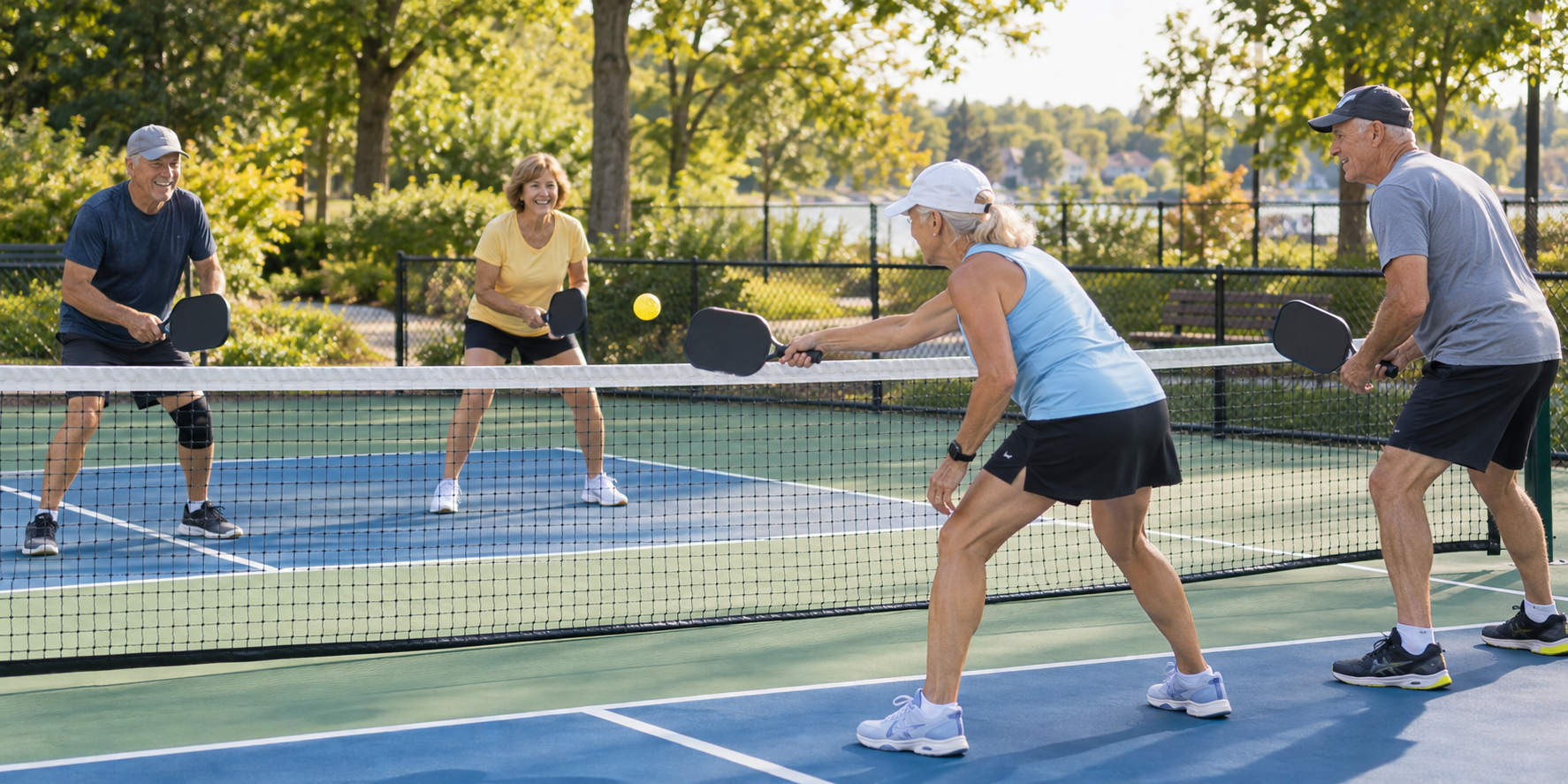
The first rally is rarely elegant. Someone serves into the net. Someone else shouts the score in the wrong order. A plastic ball makes a sound halfway between a champagne cork and a determined woodpecker. Then the ball floats invitingly over the net, you meet it cleanly with the paddle—and suddenly you understand why otherwise sensible adults reorganize their mornings around court time.
Pickleball is friendly enough to learn in an afternoon and deep enough to occupy the next decade. It combines movement, tactics, hand-eye coordination and easy conversation in a space much smaller than a tennis court. You can play gently with neighbours, chase a club rating, enter age-group tournaments or build a holiday around courts in the sun.
The secret is to begin with the right expectations: nobody needs a $400 paddle, the kitchen is not where the snacks are, and the strongest player is often the one who knows when not to hit hard.
Why pickleball fits the second act
Retirement can remove the automatic social circle that came with work. Pickleball replaces some of that structure remarkably well: a regular place to go, familiar faces, shared laughter and just enough friendly competition to make Tuesday morning feel important.
Doubles play covers less ground than tennis, yet still asks you to move, balance, react and make quick decisions. The intensity is adjustable. A recreational game can be relaxed; a fast exchange at the kitchen line can feel like trying to return popcorn in a windstorm.
You will not be joining a tiny cult—at least not numerically. Pickleball Canada’s 2026 survey estimates that 1.8 million Canadians now play at least once a month, up from one million in 2022.
- Low barrier to entry: a lesson, borrowed paddle and court shoes are enough to begin.
- Flexible commitment: play for an hour, join a weekly group or make it a serious competitive pursuit.
- Built-in community: rotating partners and open play make introductions easier than in many sports.
- Constant learning: placement, patience and teamwork matter as much as speed or strength.
- Travel potential: public courts, clubs, resorts and tournaments make the game wonderfully portable.
The game in three minutes
A regulation court is 20 feet wide by 44 feet long for both singles and doubles. The net is 36 inches high at the sidelines and 34 inches in the centre. The seven-foot area on each side of the net is the non-volley zone—universally called the kitchen.
- Serve diagonally into the opposite service court. The serve must clear the kitchen and its line.
- The serve must bounce, and the return of serve must also bounce. After those first two bounces, either team may volley the ball or play it after a bounce. This is the two-bounce rule.
- You may stand in the kitchen and play a ball that has bounced. You may not volley while touching the kitchen or its line—and your momentum after a volley cannot carry you into it.
- Traditional games are usually played to 11, win by two, with points scored by the serving side.
- In doubles, both partners normally serve before possession passes to the other team, except at the very beginning of a game. That is why the opening score is called 0–0–2.
- A ball touching a boundary line is generally in. On a serve, however, a ball touching the kitchen line is short and therefore a fault.
Your first outing: borrow before you buy
The easiest start is a municipal learn-to-play session, beginner clinic or club orientation. These provide a court, people at the same stage and often loaner paddles. One coached introduction can prevent weeks of inventing your own mysterious rules.
Tell the organizer that you are new. Pickleball players love advice—occasionally with the enthusiasm of people explaining a family recipe—so choose one instructor or patient guide and let the rest wait.
- Wear clean court shoes with lateral support; ordinary running shoes are built mostly for forward motion.
- Arrive early enough to learn the facility’s sign-in, paddle-rack and rotation system.
- Learn the score, serve, two-bounce rule and kitchen rule before worrying about spin.
- Play a short beginner game. Concentrate on keeping the ball in play, not winning the rally with one heroic swing.
- Finish while you still feel good. A first session should leave you curious, not hobbling.
What you actually need
- Paddle: Start with a forgiving midweight paddle, roughly 7.6–8.3 ounces, with a comfortable grip and a wide face. A 16 mm polymer-core paddle often offers useful control, but feel matters more than specifications.
- Balls: Indoor balls are generally softer with fewer, larger holes; outdoor balls are harder with more, smaller holes to handle wind. Ask what your local group uses.
- Shoes: Court shoes are the important purchase. Look for lateral stability, a secure heel and enough toe room. Replace them when the tread or side support is worn.
- Eye protection: Sports glasses are inexpensive compared with an eye injury and increasingly common in fast play.
- Small extras: Water, sunscreen, hat, towel and a few balls. Grip tape can make a paddle more comfortable without replacing it.
- What can wait: A special bag, ball machine, premium carbon-fibre paddle, portable net and a wardrobe that announces your new personality from across the parking lot.
A realistic Canadian cost breakdown
Pickleball can be inexpensive, but it is also very good at finding new uses for your credit card. These broad Canadian-dollar estimates were checked in September 2026; local fees and sale prices vary.
- Try-it day: about $5–$20 for municipal or club drop-in play, often with a borrowed paddle.
- Beginner paddle: roughly $60–$150. Better recreational and control-oriented paddles commonly sit around $130–$250; premium models can exceed $400.
- Court shoes: approximately $80–$180. Use suitable shoes you already own before buying another pair.
- Balls and accessories: about $15–$60 for balls, eyewear, overgrips and a basic bag.
- Group clinic: commonly $20–$50 per session, or more for a multi-week program. Private instruction in Ontario can range roughly from $60–$180 per session depending on coach, group size and facility.
- Ongoing play: free outdoor courts may cost nothing; municipal drop-ins are often modest; private indoor clubs may charge court fees, memberships or both.
- Organization membership: Pickleball Canada lists a $10 national annual fee, while Pickleball Ontario lists a $20 combined provincial and national amount before club dues and processing charges.
- Home setup: a portable net and marking supplies might cost $150–$350, but only buy them if you truly have a safe, legal surface and people ready to play.
Where to try it
Begin locally. Municipal recreation centres, arenas with gym floors, community centres, YMCAs, retirement communities and outdoor multi-use courts commonly host beginner sessions. Search for ‘learn to play,’ ‘novice,’ ‘recreational’ or ‘open play 2.0–2.5.’ Avoid walking into an advanced session and hoping charm will carry the day.
Pickleball Ontario’s club finder lists more than 70 member clubs. Around Halton, the Town of Milton publishes current indoor and outdoor options, while Burlington offers drop-in, registered and instructional programs. Private facilities in Burlington, Oakville, Mississauga and Vaughan provide year-round play, but fees and booking rules change frequently.
- Municipal drop-in: economical and low commitment; court lines, nets and skill matching vary.
- Club open play: best for community, regular partners, ladders and organized sessions.
- Private indoor facility: dependable surfaces and weather, convenient booking and usually higher cost.
- Outdoor public court: often free and wonderfully casual; bring balls, check posted rules and respect neighbours.
- Resort or travel program: an easy way to combine instruction, sunshine and social play once you know the basics.
How open play works without anyone explaining it
Many courts use a paddle rack. Place your paddle in the next open position; when a court finishes, the next group goes on. Busy facilities may use ‘four on, four off,’ while quieter ones let winners stay for a limited number of games. Ask before assuming.
Call the score loudly before serving, make honest line calls on your side and return stray balls safely rather than firing them through another rally. Introduce yourself to new partners. Do not coach strangers unless they ask. And never use ‘I’m just competitive’ as a diplomatic passport.
The best club citizens play hard without making every point heavy. They welcome newcomers, rotate fairly, apologize quickly for accidental body shots and understand that a close game is usually more fun than an easy victory.
Beginner stage: build the rally
Your first goal is not a spectacular winner. It is a dependable ball. Most beginner points end because someone misses, not because someone creates an unreturnable masterpiece.
- Use a compact swing and contact the ball in front of your body.
- Serve deep with comfortable margin. Reliability matters before power.
- Return deep, then move toward the kitchen line instead of admiring the shot from the baseline.
- Adopt a ready position: balanced feet, knees soft, paddle up and in front.
- Aim through the middle. It creates hesitation between opponents and gives you a larger target.
- Learn to stop before hitting. Reaching while still running is a reliable way to donate points.
Intermediate stage: earn your way to the kitchen
Around the 3.0 level, players can sustain rallies and begin choosing shots. The next leap is not simply hitting harder. It is learning how to move from the baseline through the transition area to the kitchen line without giving opponents an easy attack.
- Third-shot drop: a soft shot that lands in the opponents’ kitchen, buying your team time to move forward.
- Third-shot drive: a firm, controlled ball used to pressure or set up a softer next shot—not a licence to swing at the back fence.
- Reset: a soft block that takes pace off an attack and drops the ball into the kitchen.
- Dink: a patient, unattackable kitchen exchange designed to create a higher ball.
- Volley: a compact punch or block made before the ball bounces; large backswings cause trouble at close range.
- Court position: partners should generally move together, protecting the middle and avoiding a gap large enough to rent out.
Advanced stage: make fewer obvious decisions
At 3.5 and above, the game becomes less about owning every shot and more about recognizing the right one. Advanced players disguise direction, vary pace, attack only balls they can control and recover immediately after speeding up.
They also study patterns: which opponent struggles on the backhand, who retreats under pressure, when a cross-court dink opens the middle and whether a partner prefers to cover with a forehand. Fast hands help. Better anticipation makes the hands look faster.
- Develop a reliable drop, drive and reset from several court positions.
- Keep dinks low while moving opponents rather than merely surviving the exchange.
- Recognize attackable height; do not speed up a ball from below the net and hope optimism changes physics.
- Counter with a short motion and recover the paddle to neutral immediately.
- Use intentional serves and returns to create the next shot.
- Communicate on lobs, middle balls, stacking and switching before confusion becomes a strategy.
Ratings without the ego fog
Clubs often group players from roughly 2.0 to 5.0 so games remain safe, competitive and enjoyable. A beginner around 2.0–2.5 is learning rules, position and consistency. A 3.0 player sustains basic rallies and uses some dinks and volleys. A 3.5 player has greater control, strategy and shot variety. At 4.0 and above, consistency under pressure, resets, anticipation and coordinated doubles patterns become increasingly important.
Pickleball Canada adopted DUPR as its official rating system in 2025. DUPR ratings run from 2.000 to 8.000 and update as eligible results are recorded, so that official decimal is different from a casual club’s broad skill label.
A self-rating, club assessment and tournament rating are not always the same thing. Systems also evolve. Use the number to find suitable games and measure development—not as a title that must be defended at brunch.
When a club has an assessment process, respect it. Playing slightly above your comfort zone can accelerate learning; joining a session far above it can spoil the game for everyone and expose you to pace you are not prepared to handle.
Practise without becoming the person nobody invites
Games reveal weaknesses, but drills repair them. A useful split is roughly two-thirds play and one-third focused practice when improvement matters to you. Ten deliberate minutes can accomplish more than three games of repeating the same error.
- Serve 25 balls to large deep targets, then repeat from the other side.
- Return and move: hit a deep return, advance under control and split-step before the opponent contacts the ball.
- Dink cross-court with a partner, counting only balls that remain comfortably unattackable.
- Stand in the transition area and practise soft resets into the kitchen.
- Volley cooperatively at first, increasing speed only when both players keep compact form.
- Play a skinny-singles game using half the court to develop placement, movement and decision-making.
Your partner is part of every shot
Doubles pickleball is a two-person puzzle. Partners who move together make the court feel small. Partners who chase independently leave holes everywhere.
Before serving, know the score and position. During a rally, call ‘mine,’ ‘yours,’ ‘switch’ and ‘bounce’ clearly. Protect the middle according to who has the stronger angle, not according to whose forehand has a more impressive biography.
After a mistake, offer useful calm: ‘good idea,’ ‘we’re fine,’ or ‘next one.’ Eye rolls have never improved a third-shot drop.
Play for tomorrow as well as today
The smaller court can make pickleball look effortless. It is not. Quick stops, lateral lunges, backward movement and repeated reaching can challenge ankles, knees, hips, shoulders and balance—especially when enthusiasm improves faster than conditioning.
- Warm up with several minutes of walking, easy lateral movement and controlled practice shots before full-speed games.
- Wear court shoes and clear loose balls from the playing area.
- Avoid running backward for a lob. Turn, move safely and let an unreachable ball go.
- Build frequency gradually; three energetic sessions in your first week may be more excitement than your calves requested.
- Use eye protection, hydrate and take heat seriously on outdoor courts.
- Keep the paddle in front and shorten the swing to reduce wild shoulder motion and accidental contact.
- If pain changes your movement or persists, stop and seek advice from an appropriate healthcare professional.
When you want more
Once regular play feels comfortable, choose the version of ‘more’ that excites you. Join a ladder for evenly matched games. Enter a round robin with a friend. Take a targeted clinic on transition-zone play. Volunteer at a club event. Learn to referee. Try singles if your movement and recovery are ready for the extra court coverage.
Tournament divisions commonly separate players by skill and age. Before entering, read the event rules, understand which rating system it uses and confirm that your paddle appears on the applicable approved-equipment list. Your first event should be a learning day with snacks—not a referendum on your athletic identity.
Pickleball travel can range from packing a paddle for a Canadian road trip to booking a warm-weather camp. The best destination is not necessarily the one with the most courts. Look for appropriate skill groups, good instruction, shade, rest time and something enjoyable to do when your legs declare the afternoon complete.
A simple 30-day launch plan
- Week 1: Book one beginner clinic or orientation. Borrow a paddle and learn the rules.
- Week 1: Play one short novice session. Write down the two rules or situations that confused you.
- Week 2: Buy only a comfortable paddle if you are eager to return; prioritize suitable court shoes.
- Week 2: Practise serves, returns and ready position for twenty focused minutes.
- Week 3: Attend beginner open play twice, introducing yourself to at least one new person each time.
- Week 3: Ask an instructor or experienced player for one specific piece of feedback—not a complete reconstruction of your game.
- Week 4: Try a clinic, ladder or regular group at your level and put the next four sessions on the calendar.
- Day 30: Decide what you want next: social play, fitness, steady skill building, competition or pickleball travel. Your answer can change.
The B Side verdict
Pickleball deserves its popularity because it makes starting easy without making mastery easy. It creates movement with purpose, friendships without forced conversation and a reason to keep learning long after work has stopped supplying new challenges.
It is not automatically risk-free, cheap or perfectly welcoming. Good shoes, gradual conditioning, suitable skill groups and respectful court culture matter. So does accepting that a plastic ball will occasionally expose your patience in public.
Borrow the paddle. Book the clinic. Learn why everyone is standing at the kitchen line. Your first game may be chaotic—but somewhere between the wrong score and the first perfect little drop shot, you may find the hobby that gets you out the door for years.