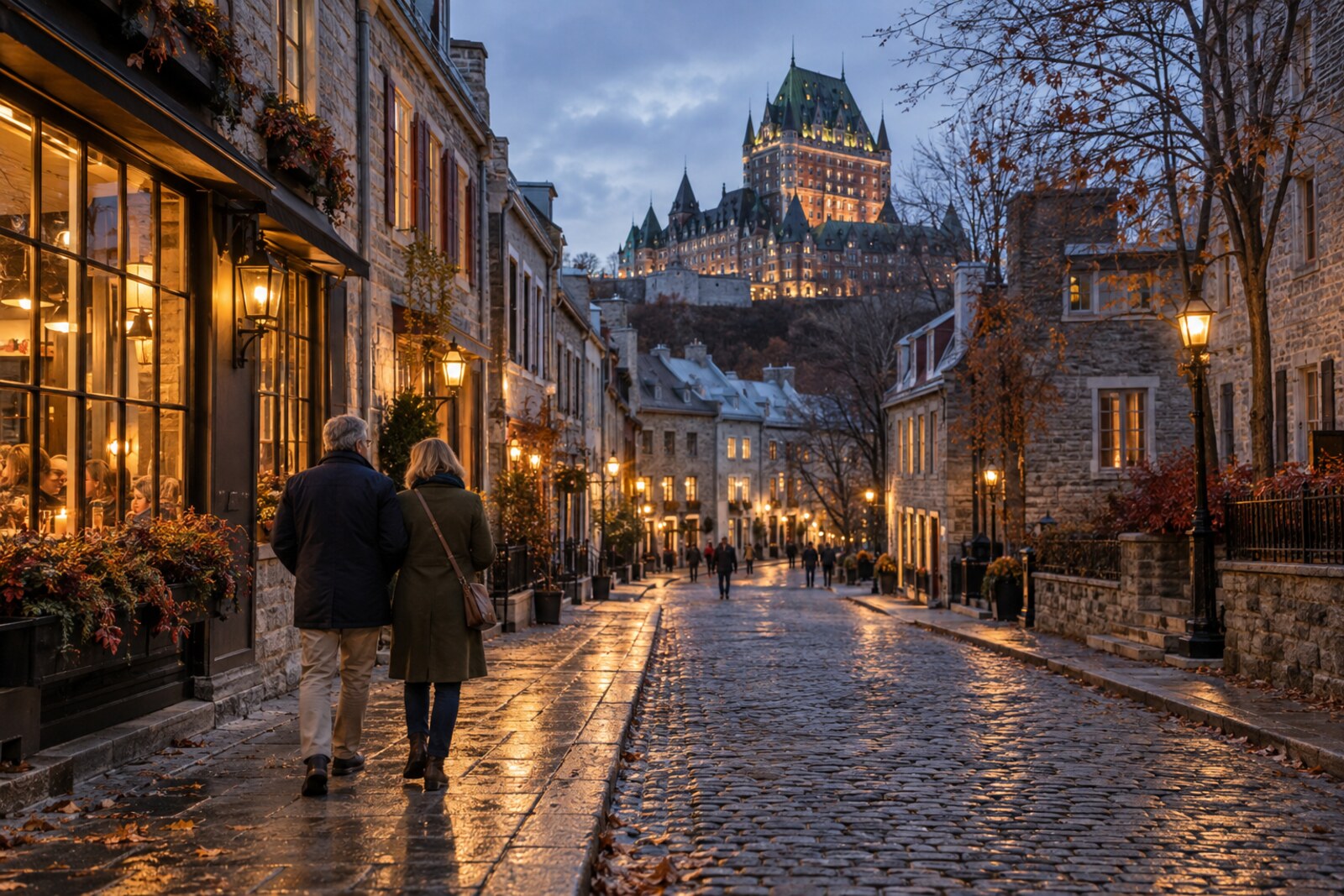
There is a brief stretch between Québec City’s blaze of autumn colour and its famous winter season when the crowds ease, hotel lobbies grow quieter and the old city feels a little more like itself.
For travellers who care more about atmosphere, good food and unhurried days than perfect weather, that in-between season is worth considering.
Québec City is well known for two very different moments. Autumn brings red-and-gold hillsides. Winter turns Old Québec into a snow globe, with the Québec Winter Carnival taking over in February.
Late October and November fall somewhere in the middle. Most leaves have dropped, ski season has not properly begun and no one is posing heroically beside an ice sculpture with a mug of hot chocolate.
That is exactly why it can be such a good time to go.
Think less snow globe and more European city break—without the overnight flight.
Who this trip suits
This is not the trip for someone who wants guaranteed snow or a full calendar of festivals. It suits travellers who enjoy old streets, long lunches, museums, bakeries and the quiet pleasure of seeing a place when it is not putting on its biggest show.
For a three- or four-night getaway, it works surprisingly well.
- Travellers who prefer atmosphere to packed itineraries
- Couples or friends who enjoy walking, cafés and good meals
- Museum and history lovers who want time to linger
- Anyone who can accept uncertain weather in exchange for lighter crowds
Why go when the weather is unpredictable?
Because almost everything else becomes easier.
Shoulder-season travel always involves a trade. You give up some weather certainty, but spend far less time competing with other visitors. Old Québec’s narrow streets are more pleasant without heavy tour-group traffic. Restaurant reservations are usually easier to find. Museums become places where you can take your time instead of somewhere everyone has escaped to at once.
Québec City also works beautifully for a mixture of indoor and outdoor exploring. Walk for half an hour, stop for coffee, visit a museum, wander through another neighbourhood and settle in for lunch before heading outside again.
You are rarely committed to spending an entire day exposed to whatever November has decided to do.
Stay where the trip is happening
On a short visit, location matters. Look first at Old Québec—especially Upper Town—or just outside the walls in Saint-Jean-Baptiste.
You may pay a little more for the room, but this is one of those trips where the right location changes the entire experience. Step outside in the morning and you are already somewhere worth exploring. If your feet are tired after lunch, returning to the hotel does not become a project. You can have wine with dinner without discussing who will drive.
After dark, when many day visitors have left, wander through the illuminated streets before heading back to your room. That quiet evening walk may become one of your favourite parts of the trip.
Saving $40 a night at a hotel fifteen kilometres away may look sensible when you book. It feels less sensible after several days of driving, parking and retrieving the car whenever you want to go anywhere.
For a short city break, walkable location is not a luxury—it is time and energy returned to the trip.
Start with the walls
Old Québec is a UNESCO World Heritage treasure and the only fortified city north of Mexico. Its historic walls remain a natural way to understand the old quarter.
The Fortifications of Québec National Historic Site is managed by Parks Canada. Its formal 2026 operating season ran from June 19 through September 7, so late-autumn visitors should not arrive expecting the complete summer program.
Instead, use the walls and gates as the loose outline for your own walk. Follow a section of the fortifications, find the old gates and notice how the city changes as you move beyond them.
Then abandon the route the moment you spot something more interesting. A trip often improves when you are willing to betray the itinerary now and then.
Give Lower Town a proper morning
One of the easiest mistakes in Québec City is treating Lower Town as somewhere to pass through quickly on the way to another attraction. Give it time instead.
Head down early, before the busiest part of the day, and wander through Petit-Champlain and Place Royale. Québec’s French colonial past feels much more immediate here than it does when you are reading about it on a plaque.
Then stop. Order coffee. Sit by the window and watch the street for a while.
There comes a point in life when you realize that spending 45 minutes in a café is not wasting 45 minutes of your holiday. You are already where you came to be.
Québec City is a very good place to be hungry
Cold-weather cities understand the importance of a proper meal. Québec City certainly does.
Late autumn gives you an excellent excuse to order food that might feel ambitious on a hot July afternoon: tourtière, French onion soup, duck, pâté, local cheese, rich sauces and something involving maple for dessert.
Not every meal needs to become a grand occasion. Choose one restaurant for a memorable dinner, then leave room for simpler pleasures. Find a bakery in the morning. Have soup for lunch. Buy a good Québec cheese. Order the dish you always notice but never quite choose.
If your room or apartment has a small kitchen, assemble one easy supper from a market. Bread, cheese, charcuterie, fruit and wine can be every bit as satisfying as another reservation.
Some of the best travel meals never arrive on white tablecloths.
Do not be intimidated by the bus
If you stay in or near Old Québec, you may not need public transportation often. The bus can still take you beyond the historic centre without the expense or nuisance of renting a car.
As of September 2026, the Réseau de transport de la Capitale listed a regular single fare at CAD $3.85 in advance or $4 cash, a one-day pass at $10.50 and a five-consecutive-day pass at $34.75. Travellers 65 and older may qualify for reduced fares with the required photo OPUS card. Confirm current prices and eligibility before travelling.
If you expect only one or two rides, individual fares will probably make more sense than a pass. More importantly, you do not have to understand the whole system before using any of it.
You only need to know which bus takes you where you want to go—and which one brings you back. That is a much smaller problem.
What does November actually feel like?
It may be cold. It may be wet. It may be unexpectedly pleasant. There is also a reasonable chance you will experience all three before dinner.
Rather than packing one enormous winter coat and hoping for the best, bring layers: a warm mid-layer, waterproof shell, gloves, a light hat and comfortable shoes with grip.
Old Québec is wonderfully walkable, but it also contains hills, staircases, cobblestones and uneven pavement. Anyone with knee, hip or balance concerns should look at the day’s route before setting out rather than assuming every picturesque street will be effortless.
There is no prize for climbing every staircase. Take the funicular when it helps. Call a taxi. Stop for coffee before you desperately need to.
Comfort is not cheating. It is how you keep enjoying the day.
Would winter be better?
If the trip in your head includes snowbanks, ice sculptures and the full theatrical Québec winter experience, then yes—wait for winter.
The Québec Winter Carnival is scheduled for February 5–14, 2027. Its program includes the ice canoe race, Bonhomme’s Ice Palace, night parades, snow and ice sculptures and outdoor activities.
That is a completely different visit: colder, busier and far more festive. For many travellers, it is wonderful.
Late-autumn Québec City is not a disappointing version of that winter trip. It has a character of its own.
A relaxed four-day plan
- Day one — Arrive by mid-afternoon and resist the urge to accomplish too much. Check in, explore Upper Town and get your bearings around the walls. Have dinner nearby and take a short walk after dark if you still have energy.
- Day two — Spend the morning in Lower Town, Petit-Champlain and Place Royale. Linger over lunch, then choose one museum or historical attraction. Leave the evening open.
- Day three — Make this your wandering day. Explore Saint-Jean-Baptiste or another nearby neighbourhood, browse independent shops, stop in a café and let a few hours pass without turning them into an achievement.
- Day four — Have breakfast somewhere you noticed earlier, take one final walk, buy something edible to bring home and leave before departure day begins to feel like a race.
Four days is enough to enjoy the city without rushing. Five is even more relaxed. Two will probably leave you wishing you booked three.
Make one weather-proof plan before leaving
Instead of scheduling every hour, make two short lists. Each morning, look outside and choose the one that makes sense.
This prevents the weather from ‘ruining’ a day it was never consulted about in the first place.
Download the free Parks Canada app before leaving. It includes maps, trip information, self-guided experiences and offline access for Parks Canada destinations.
- Fair-weather list: viewpoints, longer walks, neighbourhood wandering and outdoor historical sites.
- Wet-weather list: museums, markets, churches, galleries, cafés and one unapologetically long lunch.
The pleasure of going at the ‘wrong’ time
Peak-season travel has obvious appeal. The weather is supposedly better, everything is open and the photographs look the way you imagined.
But travelling only when a destination is at its most polished can mean missing something quieter and more personal.
Québec City in late autumn may be grey. It may drizzle. The trees may be bare.
Then evening arrives. Lights appear in the windows along the old streets. You find a warm restaurant tucked into a narrow lane. Someone sets a bowl of onion soup in front of you. Tomorrow morning, you have absolutely nowhere to be until ten.
Suddenly, November seems to be doing just fine.