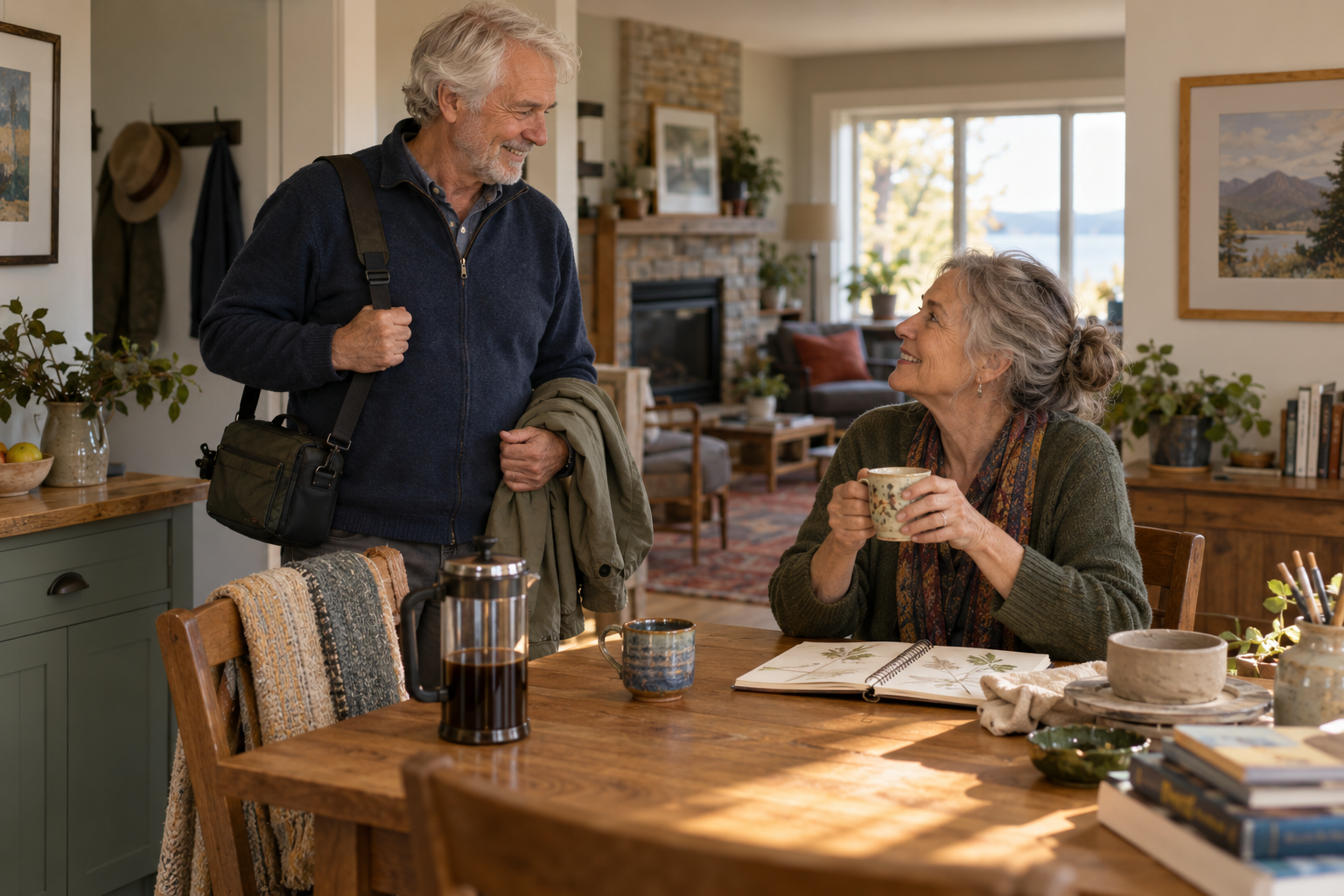
At 10:17 on a Tuesday morning, a perfectly happy couple can discover something mildly alarming.
They have already discussed breakfast, the weather, the suspicious noise coming from the dishwasher, dinner, groceries and whatever the neighbour is attempting with that ladder.
There are roughly twelve waking hours left.
For years, many couples pictured retirement as the long-awaited reward: no commute, no alarm clock and finally enough time together. Then the reward arrives and brings an unexpected question with it.
How much togetherness is actually good for us?
More time together can be wonderful. Constant proximity is something else. A strong retirement relationship usually needs both closeness and independence—and enough honesty to ask for either one without making it sound like rejection.
Wanting an afternoon to yourself is not a referendum on the marriage.
The relationship may be fine. The rhythm has changed.
Work did much more than provide a paycheque. It gave the day a shape. There were colleagues, deadlines, frustrations, coffee breaks and hours spent in a world your partner did not share.
You came home carrying news. Even a complaint about somebody reheating fish in the office microwave was, technically, fresh material.
Retirement can remove that whole structure almost overnight. Statistics Canada reported that the average retirement age across Canadian workers reached 65.4 in 2025, but whatever age it happens, the shift is larger than simply having more leisure.
One partner may be thinking, ‘At last, we can do everything together.’ The other may be picturing long mornings alone, a weekly golf game and the blessed silence of nobody asking what the plan is.
Neither person is wrong. They are simply working from different drafts of retirement—and trouble tends to begin when each assumes the other received the same copy.
Stop measuring love in hours
I do not find the idea that happy couples should spend nearly all their free time together especially romantic. Mostly, it sounds exhausting.
Your partner cannot reasonably be your spouse, best friend, travel companion, exercise partner, hobby partner, therapist, entertainment committee and entire social network. That is too much weight for one person and too much sameness for one relationship.
Some couples genuinely enjoy doing almost everything together. Others are at their best with a fair amount of independence. Most sit somewhere in the middle, and that middle can move over time.
The useful question is not, ‘How many hours should a good couple spend together?’ It is this:
Does our current balance leave both of us feeling connected—or does one of us feel crowded while the other feels forgotten?
That is a far more honest measurement.
Closeness is about the quality of contact, not a shared timesheet.
When one person retires first
This is where many otherwise sensible couples get blindsided.
Suppose you retired two years ago while your partner kept working. You built a new rhythm. You walk in the morning, run errands when stores are quiet, meet a friend for coffee and protect Thursday afternoon for a project you enjoy.
Then your partner retires.
From their side, retirement has just begun. From yours, somebody has moved into your Tuesday.
You may be delighted to have them home and still resent the sudden commentary on when you go out, what you eat for lunch and why you need three hours at the hardware store. Both feelings can be true.
Meanwhile, the newly retired partner may have spent years imagining shared outings and leisurely lunches. They are not trying to invade a routine. They may not even realize a routine exists.
This is how loving people end up irritating each other while both remain convinced they are being entirely reasonable.
Talk before somebody says the unforgettable thing
Do not wait until one person snaps, ‘Do you have to come with me everywhere?’ That sentence has remarkably good staying power.
Have the conversation when nobody is already defending themselves. Try: ‘I want us to think about what we would like our weeks to feel like now. What do you especially want us to do together, and what would you enjoy keeping as your own?’
Then answer the question yourself. Specifics are much kinder than vague complaints.
You might say, ‘I love our morning coffee and I want to keep it.’ Or, ‘I would like one evening a week when we deliberately go somewhere together.’ Then add, ‘I also want to keep cycling with my group on Thursdays,’ or, ‘I think I would enjoy having the house to myself occasionally.’
That language matters. You are describing a life you want to build together, not presenting an escape plan.
Use anchors, not constant togetherness
Most couples benefit from a few dependable rituals. They do not need to involve reservations, flowers or matching activewear.
Morning coffee. A walk after dinner. Friday lunch out. Sunday breakfast. One evening when you cook something new. A regular drive to the cottage with the same terrible snacks.
These are relationship anchors. They tell both people, ‘We have time that belongs to us.’
Once that connection is dependable, separate time often feels less loaded. If you know you are having breakfast together tomorrow and dinner out Friday, your partner disappearing into the workshop on Wednesday afternoon does not look like withdrawal.
It just looks like Wednesday.
Keep something that belongs to you
Retirement is a good time to retrieve interests that work and family life pushed to the edge. Kayaking, photography, gardening, volunteering, painting, golf, hiking, woodworking, music or a language you have been threatening to learn since 1998.
Your partner does not have to join.
In fact, it may be healthier if they do not.
Separate interests put new oxygen into a relationship. One person volunteers for the morning. The other takes a camera to the conservation area. At lunch, they have something to tell each other.
It sounds almost too simple, but conversation needs fresh material. When you witness every minute of each other’s day, ‘How was it?’ becomes a fairly pointless question.
But do not become two polite tenants
There is a difference between independence and two parallel lives that occasionally meet beside the kettle.
Shared novelty matters too. A well-known series of studies led by psychologist Arthur Aron found that couples who took part in novel, stimulating activities together reported greater improvements in relationship quality than couples assigned more ordinary activities.
This is not an instruction to buy a parachute.
Try a restaurant in another neighbourhood. Take a cooking class. Visit a town neither of you knows. Rent bicycles somewhere new. Learn cribbage. Catch a train for the day. Plan a trip and each choose one thing the other person would never have selected.
The point is to be beginners together. Neither person is merely tagging along inside the other’s established hobby; you are both finding out what happens next.
Know the difference between space and withdrawal
Healthy independence still contains warmth. People separate, return, talk and remain interested in each other.
Withdrawal feels different. One partner increasingly avoids conversation, abandons things they once enjoyed together or uses a hobby mainly to stay away from unresolved tension.
On the other hand, wanting an evening alone is not proof that something is wrong. Some people recharge through solitude. Others recharge by talking to anyone who remains within range. Retirement does not erase those temperamental differences.
If you are unsure what your partner’s behaviour means, ask before your imagination writes a darker story.
‘I have noticed you have been spending more evenings downstairs. Are you simply enjoying the quiet, or is something bothering you?’
Curiosity is much more reliable than mind-reading.
Keep other people in the picture
Couples need friends. That becomes especially important when workplace contact begins to disappear.
Encourage outside friendships rather than treating them as competition. If your partner has lunch with an old colleague every Wednesday, that is not time stolen from the relationship. It is one strand in a larger, healthier life.
The same applies to your friendships. The Canadian Coalition for Seniors’ Mental Health distinguishes loneliness from social isolation and emphasizes meaningful social connection as part of healthy ageing.
A partner can be the most important person in your world. They should not be required to populate the whole thing.
Please stop supervising the dishwasher
More time at home can produce an odd retirement habit: managing each other.
One person loads the dishwasher incorrectly. The other folds towels using a method apparently prohibited by international law. Somebody buys the wrong tomatoes and is invited to explain themselves.
Retirement gives couples enough time to develop strong opinions about jobs that once happened unnoticed.
Resist the temptation. If your partner has taken responsibility for a household task and the result is acceptable, let them do it their way.
There are only so many years available. Spending them litigating the correct direction for teaspoons seems like poor resource allocation.
Try the Ours, Mine & Yours experiment
Then add one thing to each category. Perhaps Ours gets breakfast somewhere new on Saturday. Mine gets a Tuesday cycling group. Yours gets a Thursday pottery class.
Try the arrangement for a month. Do not treat it like a constitutional amendment. If it feels lopsided, adjust it.
Retirement itself is an experiment. The timetable is allowed to change.
- Ours: Things you genuinely enjoy doing together.
- Mine: Your activities, friendships and quiet time.
- Yours: Your partner’s activities, friendships and quiet time.
The goal is not equal hours. It is a balance that feels fair and alive to both people.
A little distance can bring you closer
There is a lovely paradox in a long relationship.
You leave. You do something. You come back. There is news.
Retirement gives couples a rare gift: more control over their time. The best use of that gift is not necessarily spending every available minute in the same room.
Sometimes love looks like coffee together every morning. Sometimes it looks like disappearing for three hours to paddle, paint, volunteer, golf or wander through a bookstore without being asked how much longer you will be.
Then you come home, look at the person you chose and ask, ‘How was your day?’
And, for the first time since 10:17 that morning, you genuinely do not know the answer.
What is one thing you would like to protect as ‘ours’—and one thing each of you would enjoy having as your own?