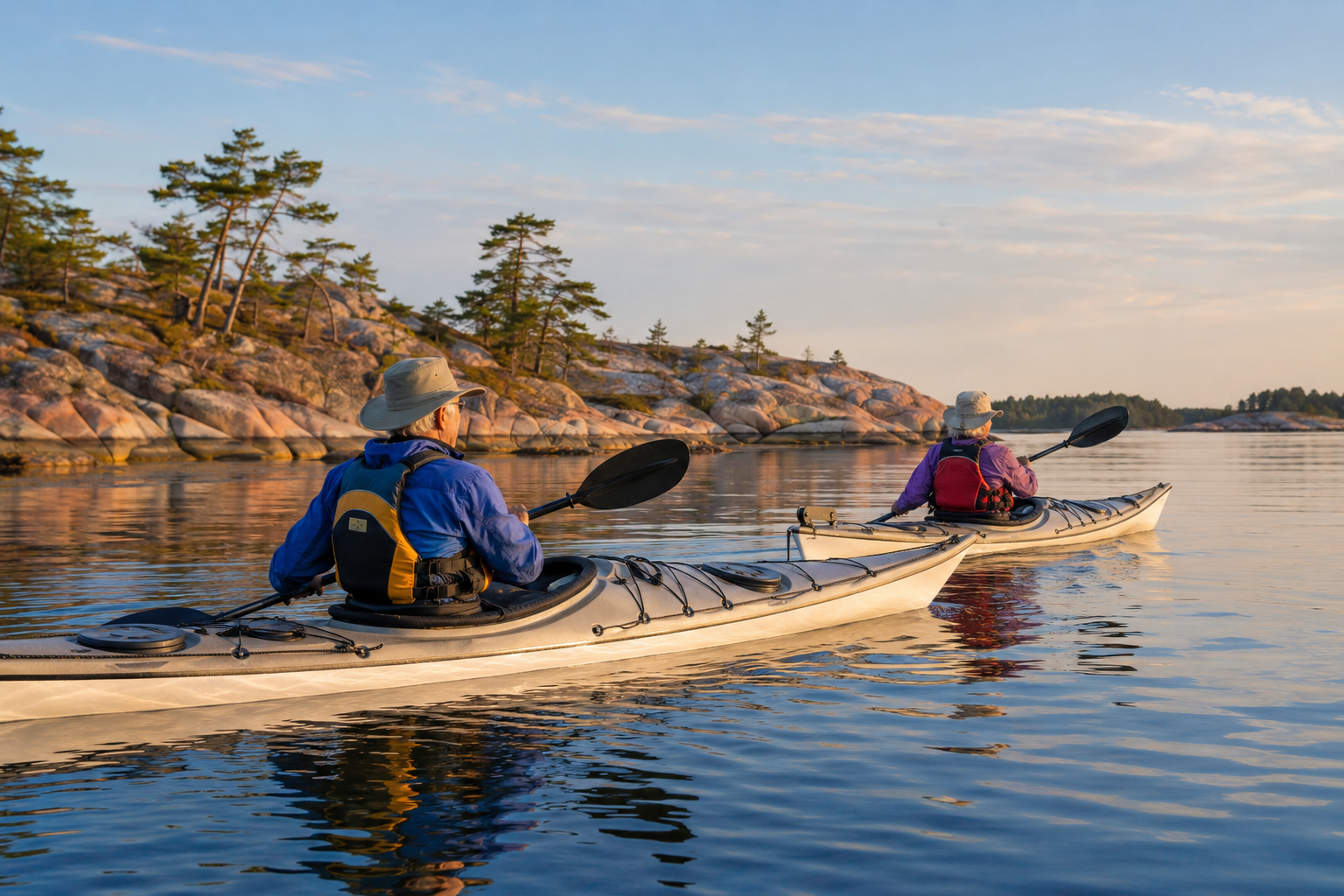
A sea kayak can take you into a world most people only see from shore: a quiet cove at sunrise, a granite island reached in time for lunch or a seal surfacing just beyond your bow.
That sense of discovery is what makes sea kayaking such a rewarding retirement hobby. It can be a gentle two-hour outing on protected water, a weekly ritual with friends or the beginning of multi-day journeys. You choose the scale—and the hobby can keep growing as your confidence does.
Why it works so well after 50
Sea kayaking blends movement, concentration and time outdoors without requiring speed or competition. With efficient technique, the whole body contributes: the legs connect you to the boat, the torso powers the stroke and the arms guide the paddle.
It also gives the week shape. There are routes to plan, forecasts to interpret, skills to practise and people to meet. Some paddlers value the quiet; others find their community through clubs, courses and regular group outings.
- Low-impact movement that can be adjusted to your pace and endurance.
- A genuine learning curve—strokes, rescues, navigation and weather judgment.
- Easy access to nature without needing to cover long distances on foot.
- Room for solitude, social paddles, travel or wilderness camping.
- A hobby that rewards patience and judgment more than raw strength.
Before you buy anything: try three paddles
The most expensive mistake is buying the wrong kayak before you know what comfortable feels like. Rent or take a guided outing at least three times, ideally in more than one boat.
A proper sea kayak is longer and narrower than a casual recreational boat. It usually has sealed bulkheads, deck lines and storage hatches. It may feel lively at first, but good fit and instruction quickly make it feel more controlled.
Pay attention not only to the hour on the water, but also to carrying, loading, launching and getting out. For many paddlers over 50, handling the boat on land is the real challenge. A kayak cart, load-assist rack, lighter boat or help from a paddling partner can matter more than another premium accessory.
Stage one: calm water and confident basics
Begin on warm, protected water close to shore, with an easy launch and several landing options. Keep early sessions to 60–90 minutes and finish wanting a little more.
Paddle Canada’s Basic Kayak Skills curriculum includes lifting and carrying, launching, forward and reverse strokes, sweep turns, draws, low braces, edging, safety equipment and risk assessment. A lesson turns trial and error into a much shorter—and safer—learning curve.
- Learn a relaxed forward stroke and how to stop and turn both ways.
- Practise a controlled wet exit with a qualified instructor if using a sit-inside kayak.
- Learn an assisted re-entry before relying on open-water outings.
- Check the wind forecast and identify where you can land before launching.
- Wear your PFD from shore to shore; do not merely carry it.
- Paddle with a capable partner and leave a float plan with someone ashore.
Stage two: become a capable day-tripper
Once the basics feel automatic, move into longer day trips along shorelines with frequent landing options. This is where sea kayaking becomes more than exercise: you begin reading the water, choosing routes and managing a day as part of a group.
Paddle Canada Sea Kayak Level-1 is a two-day course that moves beyond flat water and emphasizes re-entry, day-trip planning, navigation, weather and appropriate clothing. Level-2 is a four-day intermediate course for moderately exposed shoreline and possible overnight travel; leadership, open-water rescue, self-care and navigation are central.
- Refine edging, draw strokes, braces and efficient forward paddling.
- Learn chart and compass basics rather than depending entirely on a phone.
- Practise both assisted and self-rescues in realistic clothing.
- Build distance gradually and keep enough energy for changing conditions.
- Pack water, food, sun protection and warm dry layers for every outing.
- Treat group communication and staying together as paddling skills.
Stage three: adventure on your terms
Advanced paddling is not about proving bravery. It is about having more options and better judgment when wind, waves, current or an unexpected swim changes the plan.
Some paddlers work toward a reliable kayak roll, surf-zone skills, rough-water rescues, expedition planning or trip leadership. Others are perfectly fulfilled exploring protected shorelines for decades. A roll is useful, but it is not a requirement for enjoying the sport; dependable re-entry skills and conservative decisions come first.
Take higher-level training in progressively challenging conditions. Remote coastlines, big crossings, tidal currents and cold open water should never be the classroom for skills you have not already practised.
What it really costs in Canada
A sensible path is to rent through the first course, buy a well-fitted PFD first and shop for a kayak only after trying several models. Used equipment can reduce the investment dramatically, but have an experienced paddler inspect the hull, outfitting, hatches and deck lines.
- Try-before-you-buy: roughly $40–$150 per outing for a rental, lesson or guided experience.
- Comfortable PFD: about $120–$250.
- Touring paddle: about $150–$400; lighter paddles reduce fatigue but cost more.
- Used touring kayak: often $800–$1,800, depending on age, material and condition.
- New rotomoulded sea kayak: commonly $1,500–$2,800; composite boats often begin around $3,500 and can exceed $6,000.
- Cold-water clothing: from a few hundred dollars for suitable layers and a wetsuit to roughly $1,200–$2,000 or more for a quality drysuit and insulating layers.
- Transport and rescue gear: allow roughly $300–$900 for racks, a cart, pump, paddle float, dry bags and communication equipment.
Safety is what creates freedom
Canadian law sets minimum equipment requirements for human-powered craft, but the legal minimum is not a complete sea-kayaking kit. Consult Transport Canada’s current Safe Boating Guide for your craft and trip.
- Wear a properly fitted, Canadian-approved PFD and carry the required safety equipment.
- Dress for the water temperature, not the air. Cold water can overwhelm a swimmer even on a sunny day.
- Carry reliable communication suited to the location: a protected phone near shore, and often a marine VHF radio or personal locator beacon farther afield.
- Check wind, waves, thunderstorms, currents and water temperature—not only the chance of rain.
- Carry a pump, paddle float, spare paddle, first-aid supplies, repair items and extra clothing as the trip demands.
- Leave a float plan with your route, group, vehicle, launch point and expected return time.
- Avoid paddling alone until you can reliably manage a capsize and understand the local risks.
Canadian waters worth growing toward
You do not need an ocean to sea kayak. Canada’s Great Lakes offer true open-water touring, while thousands of smaller lakes provide ideal practice.
- Kawartha Lakes and other protected Ontario waters: convenient places to build regular mileage and technique.
- Thousand Islands: intricate shorelines and island routes, with boat traffic and current demanding awareness.
- Georgian Bay: classic Canadian Shield scenery, from sheltered island clusters to serious exposed crossings.
- Lake Superior near Rossport and the Slate Islands: exceptional water and coastline, but cold temperatures and rapidly changing conditions deserve respect.
- Gulf Islands and Vancouver Island, British Columbia: wildlife, tides and extraordinary multi-day possibilities with appropriate coastal training.
- Nova Scotia and New Brunswick: memorable coves, islands and working coastlines; the Bay of Fundy’s powerful tides require local knowledge and careful planning.
The community may become the best part
A course gives you skills; a club gives you reasons to keep using them. Local paddling groups often organize short evening outings, day trips, pool rescue sessions and longer journeys. They are also one of the best places to learn about launch sites, wind patterns and trustworthy used equipment.
As experience grows, the hobby can create purpose beyond personal adventure. You might help with club events, support new paddlers, volunteer on shoreline cleanups or eventually pursue leadership and instructor training. Retirement leaves room not only to learn, but to pass something on.
Your first 30 days
- Find a Paddle Canada instructor, paddling school or reputable local outfitter.
- Book an introductory lesson or guided outing on protected water; rent all equipment.
- Try at least two different kayaks and note comfort, stability and ease of entry—not colour or speed.
- Practise a wet exit and assisted re-entry with qualified supervision.
- Join one easy social paddle that matches your current ability.
- Only then make a gear plan based on the paddling you will actually do most often.
The B Side verdict
Sea kayaking is an unusually complete retirement hobby: physical without being punishing, peaceful without being passive and adventurous without demanding that every outing be extreme.
Start small. Take instruction. Buy slowly. Let calm water build your technique before beautiful places test it. Your first paddle may last an hour—but it can open a chapter that lasts for years.