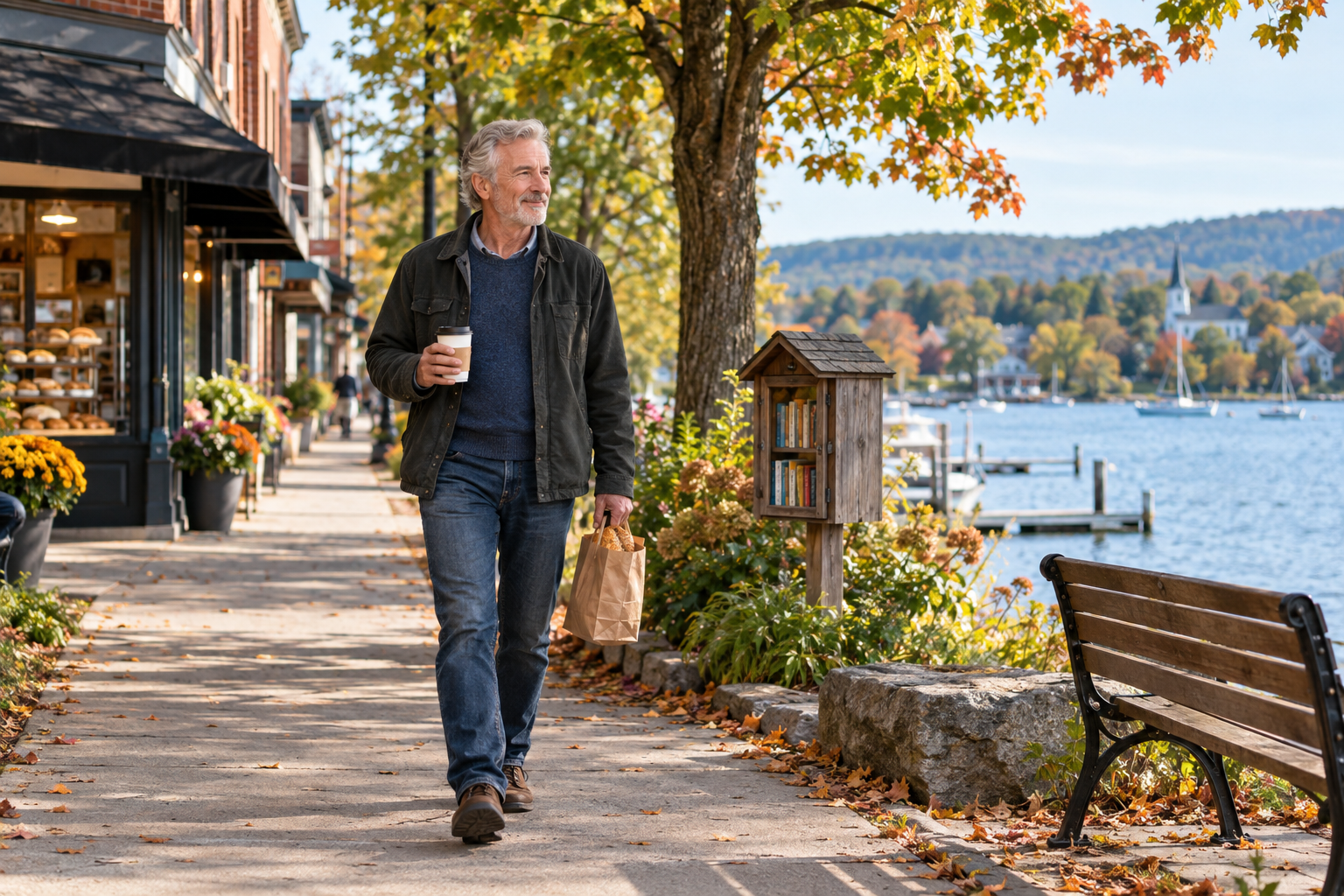
Retirement gives you something that a busy working life rarely does: the chance to stop treating every ordinary task as something to get through.
For most of our adult lives, being efficient makes sense.
Take the quickest route. Order ahead. Use self-checkout. Combine three errands into one trip. Eat something fast because the evening is already spoken for.
After a while, we get remarkably good at shaving minutes off the day.
Then retirement changes the calculation. Time still matters, of course. But saving every possible minute may no longer be the goal.
Sometimes the longer way is the better one.
Walk to get the coffee instead of driving. Cook the meal instead of heating something up. Take the road along the lake. Browse the shelves instead of ordering the book online. Sit down with your coffee rather than carrying it back to the car.
Not because slower is always better. Sometimes a quick errand is exactly what you want.
But every now and then, the supposedly inefficient part is where the actual living happens.
Sometimes the longer way is the better one.
We got very good at getting things done
Working life rewards efficiency, and for good reason.
When lunch has to fit into 40 minutes, nobody suggests making fresh pasta. When you still need groceries after a long day, visiting three independent shops sounds considerably less charming than getting everything in one place.
You get what you need and move on.
The trouble is that the habit can stick around long after the time pressure has eased.
We still hurry through the grocery store. We still choose the quickest route without thinking. We eat lunch standing at the counter and treat errands as obstacles between us and whatever we are supposed to be doing next.
But what if there isn't always a next thing?
What if, once in a while, the errand itself could be part of the day?
Frank went out for bread
Let's call him Frank.
One Saturday morning, Frank needed bread. The supermarket was ten minutes away by car. He could have driven there, picked up a loaf and been home within half an hour.
Instead, he remembered a bakery about four kilometres away. The weather was good, so he walked.
Along the way, he stopped to look at a house being renovated. He came across a little free library he had never noticed before and found a book that looked worth taking home.
At the bakery, he bought his bread and decided to stay for a coffee. Someone at the next table noticed the book and asked him about it. They talked for ten minutes.
Frank took a different route home.
The bread run lasted nearly two hours.
As an exercise in efficiency, it was terrible. As a way to spend a Saturday morning, it was pretty good.
The bread run lasted nearly two hours. As an exercise in efficiency, it was terrible. As a Saturday morning, it was pretty good.
Turn an errand into an outing
This is probably the easiest place to start.
Not every errand needs to become an experience. Sometimes you need toothpaste and would simply like to acquire toothpaste.
But every so often, choose the less efficient version.
The errand already gives you a destination. All you are changing is what happens around it.
- Buy the bread at the bakery or the vegetables at the farmers' market.
- Walk somewhere you would normally drive, if the distance and weather make sense.
- Pair an appointment with lunch somewhere nearby.
- Take a different route home and stop at the place you keep passing.
Make something you normally buy
Convenience is a wonderful thing. Nobody needs to churn butter to prove they are making good use of retirement.
Still, making something yourself now and then can change the feel of an ordinary day.
Bread. Soup. Pizza dough. A birthday card. A planter box. A batch of tomato sauce. A simple repair you have always paid someone else to do.
The finished result may not be better than the store-bought version. That isn't necessarily the point.
When you make something, you spend time with the process instead of jumping straight to the outcome. You notice the ingredients. You solve a few small problems. You learn something. Maybe you make a mess.
And homemade pizza with a slightly questionable shape can still taste excellent.
Choose the scenic route on purpose
GPS is very good at answering one question: What's the fastest way there?
Useful question. Not the only one.
You could also ask: What's the most interesting way there?
Take the road beside the lake. Drive through the small town instead of around it. Leave the highway an exit early. Pull over at the lookout you have passed twenty times and never visited.
Travel doesn't have to begin at an airport. Sometimes a 40-minute drive becomes a 90-minute wander, and the extra 50 minutes are the part you remember.
Let a conversation run long
We can be efficient with people too.
Send the quick text. Exchange the necessary information. Say, ‘We should catch up soon.’ Then get on with the day.
But conversations often need a little room before they get interesting. The first ten minutes may be updates: the weather, the family, what everyone has been doing. A little later, someone tells you what has actually been on their mind.
When you have the chance, don't rush toward the natural exit.
Have another coffee. Stay on the porch a little longer. Take the longer walk. Ask one more question.
You don't need to do it every time. But many of the conversations we remember happen after the efficient version would already have ended.
Notice when you're rushing for no reason
This may be the most useful habit of all: catch yourself hurrying and ask one simple question.
What am I rushing toward?
Sometimes there will be a perfectly good answer. An appointment. A commitment. Someone waiting for you.
Fair enough. Keep moving.
But occasionally the honest answer will be: nothing, really.
That is your cue to ease up. Look around. Finish your coffee at the table. Take the extra street. Stay another ten minutes.
Knowing how to hurry is useful. Knowing when you don't need to may be even better.
What am I rushing toward?
One small step for today
Take 15 minutes and think of one ordinary thing you will do this week: an errand, a meal, a drive, a coffee or a walk.
Now ask yourself: What would the slightly longer, more enjoyable version look like?
Keep it simple. Walk to the café instead of driving. Cook one meal from scratch. Take the lake road home. Buy your vegetables at the market and have a real conversation with the person selling them.
Choose one thing. Then give yourself permission not to optimize it.
- Choose one ordinary thing already on your calendar this week.
- Picture the slightly longer, more enjoyable version.
- Give it an extra 15 minutes and leave efficiency out of it.
You don't have to save every minute
Efficiency is a useful tool. It just doesn't have to become a philosophy of life.
Retirement gives you the chance to reconsider what a minute is for.
Some minutes are worth saving. Others are worth spending generously—on a conversation, a walk, a meal, a back road or a cup of coffee you drink sitting down.
The longer way isn't always better. But sometimes it holds things the shortcut misses.
After years of trying to squeeze more into every day, there is something quietly satisfying about realizing you don't always have to.
What ordinary part of your week might become more enjoyable if you stopped trying to finish it as quickly as possible?
Some minutes are worth saving. Others are worth spending generously.